Published by: Élodie Maurel-Lescure — Editor specializing in various
The movement Arts and Crafts is born of a simple idea: an object of everyday life can be beautiful, useful and meaningful if it is carefully designed. In the 19th century England, this reaction to the Industrial Revolution marked the decorative arts, architecture, furniture, graphics and modern way of thinking responsible design.
Contents
A movement born against mass industrial production
The Arts and Crafts movement emerged in the 1860s in the United Kingdom, in a context of rapid urban, workshop and manufacturing transformation. Industrialization makes it possible to produce faster and cheaper, but it also leads to a standardization of forms, a perceived decrease in quality and a separation between the person drawing, the person making and the person selling. The current then spreads beyond the UK, particularly in Europe, where it provides a broader reflection on the role of the creator and the value of manual work.
Understanding the Arts and Crafts
The defenders of the Arts and Crafts criticize aesthetics considered poor in industrial production. They also denounce the organisation of work which often reduces the worker to a repetitive gesture, far from the complete mastery of know-how. For them, the beauty of a piece of furniture, wallpaper or book comes as much from its shape as from the conditions under which it was thought and produced. This idea gives the design social as well as artistic significance.
An artistic, social and moral reform
The Arts and Crafts are not a simple decorative style. It is an artistic movement, but also a philosophy of creation. He defends the idea that art must enter daily life, not stay locked in museums or reserved for elites. Domestic objects, textiles, stained glass windows, books, wallpapers and houses become full spaces of expression.
This ambition explains the importance given to natural materials, visible techniques and consistency between function, structure and ornament. A plant motif is not added as a superficial decoration, it must dialogue with the material, use and general form of the object. The movement thus seeks a more readable, fairer and closer to everyday creation.
The founding principles: useful beauty, visible hand and honest materials
The heart of the movement rests on a simple conviction: there must be no rigid boundary between the artist and the craftsman. The designer must understand the manufacturing, and the manufacturer must be able to exercise his aesthetic judgment. This idea ofartisan-artist gives manual work a new cultural and social dignity.
Handmade as a sign of quality, not as simple nostalgia
Handcrafts is central in the Arts and Crafts, but it is not about copying the past out of taste of the picturesque. The movement values participation in all stages of creation, from drawing to choice of material, to manufacturing and finishing. This continuity makes it possible to produce more coherent, durable and expressive objects.
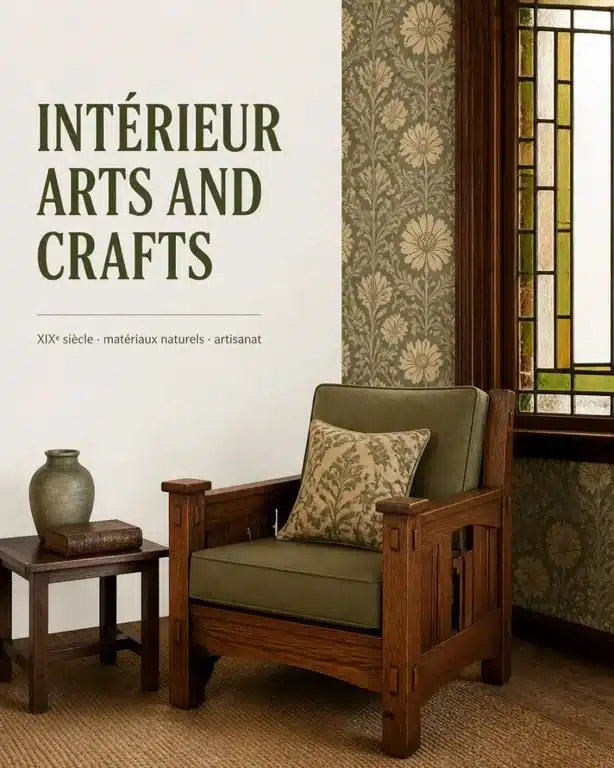
Wood, stone, metal, leather, glass or textile fibres are appreciated for their own qualities. A surface may retain an irregularity, vein or tool trace if this reveals the manufacturing process. On the other hand, industrial pastiche, which imitates artisanal luxury without bearing its logic, is strongly criticized. The movement defends honesty of matter and gesture.
Ornament, nature and legibility
Visually, the Arts and Crafts often favour nature-inspired motifs: foliage, flowers, birds, interlaced stems. But these ornaments generally remain structured, legible, suitable for support. In a wallpaper, fabric or binding, the pattern must respect the surface instead of masking it. The decoration accompanies the shape instead of crushing.
The line of a chair back, the rhythm of a vegetable pattern, the texture of a paper or the veining of a wood must remain clear for the eye. This logic helps to recognize the movement: ornament is not an overload, it serves the structure, use and perception of the object. The result is a balance between simplicity, precision and manual presence.
Major figures and iconic works to know
Several artists, thinkers, architects and designers have given the Arts and Crafts movement its intellectual and visual strength. Their journeys show that this current affects both ideas and objects, with the same requirement of consistency between creation, manufacture and use.
The anti-imperialist reinterpretation of William Morris' motives | This article examines how William Morris's motifs, a figure of the Arts and Crafts, are re-read and re-interpreted in contemporary art.
John Ruskin and William Morris, the two founding figures
John Ruskin is one of the great inspirations of the movement. An art critic and social thinker, he defends the importance of human work, the sincerity of materials and the moral value of art. His ideas feed a profound critique of industrialization and its effects on creativity and on the dignity of work.
William Morris then embodied this thought in concrete achievements. Designer, writer, publisher and entrepreneur, he creates textile motifs and wallpapers that have become emblematic. It defends a production where the beauty of ordinary objects contributes to an improvement of daily life. Its Kelmscott Press also illustrates the importance attached to the book as a complete object: typography, layout, paper, illustration and binding must form a harmonious whole.
Philip Webb, Red House and inhabited architecture
The Red House, designed by Philip Webb for William Morris, is often cited as a major example of the Arts and Crafts spirit applied to habitat. The house is not thought of as a spectacular facade, but as a coherent place of life, where architecture, furniture, decoration and domestic uses respond.
This approach announces an essential idea of modern design: the object or building must be designed according to real life. The Arts and Crafts do not separate the chair from the room, the wallpaper from the light, or the door handle from the daily gesture. Everything must work together, with no free effect.
Guilds, associations and dissemination of the movement
The movement is also structured around guilds and associations. The creation of Arts and Crafts Exhibition Society in 1887 played an important role in the visibility of creators and in the recognition of decorative arts. Figures like Charles Robert Ashbee, linked to the Guild of Handicraft, prolong this desire to organize artisanal work differently.
These initiatives show that the Arts and Crafts are not just about a few big names. The movement is also based on workshops, communities of practice, exhibitions and transmission networks. It is part of a collective dynamic, where the flow of know-how counts as much as individual signature.
Arts and Crafts, Art Nouveau and Handicrafts: Do Not Confound
The term "arts and crafts" may lead to confusion, especially in contemporary English where it often refers to creative leisure, DIY or manual activities. The historical Arts and Crafts movement, on the other hand, corresponds to a precise artistic and social current, which appeared in the 19th century, with a clearly identifiable philosophy, actors and context.
| Concept | Period and context | Main characteristics |
|---|---|---|
| Arts and Crafts | United Kingdom, reaction to industrialisation | Crafts, natural materials, social reform through design, useful and beautiful objects |
| Art Nouveau | Late 19th century and around 1900 | Curved lines, very expressive plant motifs, architecture and decorative arts |
| Current manual arts | Contemporary leisure or creative practices | DIY, creative leisure, personal manufacturing, technical or decorative learning |
Art Nouveau shares with the Arts and Crafts an interest in nature, decorative arts and unity between art and everyday life. But it often moves towards more fluid, more ornamental, sometimes more spectacular lines. The Arts and Crafts remain strongly committed to the structure, sincerity of the material and social criticism of mass production.
As for the modern manual arts, they can resume certain gestures of movement: manufacture, repair, personalise, work a material. But they do not necessarily have the same ambition of social reform, nor the same global reflection on the economy, the workshop and the place of art in society.
A legacy always alive in contemporary design
The influence of the Arts and Crafts movement far exceeds its time. It inspires Art Nouveau, nourishes reflections on modern design and prepares, through certain aspects, the idea that an object must be thought in its use, its manufacture and its environment. Even when the Bauhaus has a more favourable relationship with industry, the question raised by the Arts and Crafts will remain central: how to produce beautiful, useful and accessible objects without impoverishing work or quality?
What the current design still owes it
In contemporary design, the Arts and Crafts heritage is recognized in the attention paid to materials, durability, traceability and manufacturing ethics. The return of craftsmanship, short circuits, designer workshops or makers practices reactivates some of this sensitivity, even in very different forms. The logic remains the same: understanding how an object is made to better judge its value.
The movement also reminds that an object is never neutral. A chair, lamp, garment or book tell a way to produce, consume and inhabit the world. This is what makes the Arts and Crafts still current: behind their floral motifs and wooden furniture, they ask a very modern question about the relationship between beauty, work and responsibility.
How to Recognize the Mind Arts and Crafts Today
To identify a Arts and Crafts influence, first observe the consistency between form and use. Does the object seem designed to last? Are the materials assumed rather than hidden? Does the decoration accompany the structure instead of covering it? Does manufacturing allow for human attention? These clues give a simple and useful reading, whether it be an antique piece of furniture, a binding or a contemporary creation.
The essential is not to find an exact copy of the British style of the 19th century. Rather, it is a question of understanding the attitude that enlivens. The Arts and Crafts defend a creation where hand, thought and matter remain linked. It is this alliance that still makes their strength.
Updated on 25 August 2026