

Published by: Élodie Maurel-Lescure — Editor specializing in various
Updated on 23 March 2026
Whether it is to facilitate the sharing of printers in a workshop or simply to succeed in connecting Sacha's console to the family box, better understand the key role of a network switch really eases the management of your equipment on a daily basis. Accessible but also flexible, this small housing guarantees a smooth and secure flow of data between different devices, making it more efficient and comfortable, both at home and in professional environments. Choose a switch adapted to your current park, while preparing for the future, is based on some accessible principles (useless to get lost in jargon). It is the kind of detail that helps to approach its facilities more calmly and to make its local network reliable.
Summary of key points
- ✅ The network switch facilitates and secures the management of connected equipment.
- ✅ It optimizes data flow by avoiding unnecessary collisions and dissemination.
- ✅ Choosing a suitable switch simplifies installation and prepares the future of the network.
Contents
What is a network switch for?

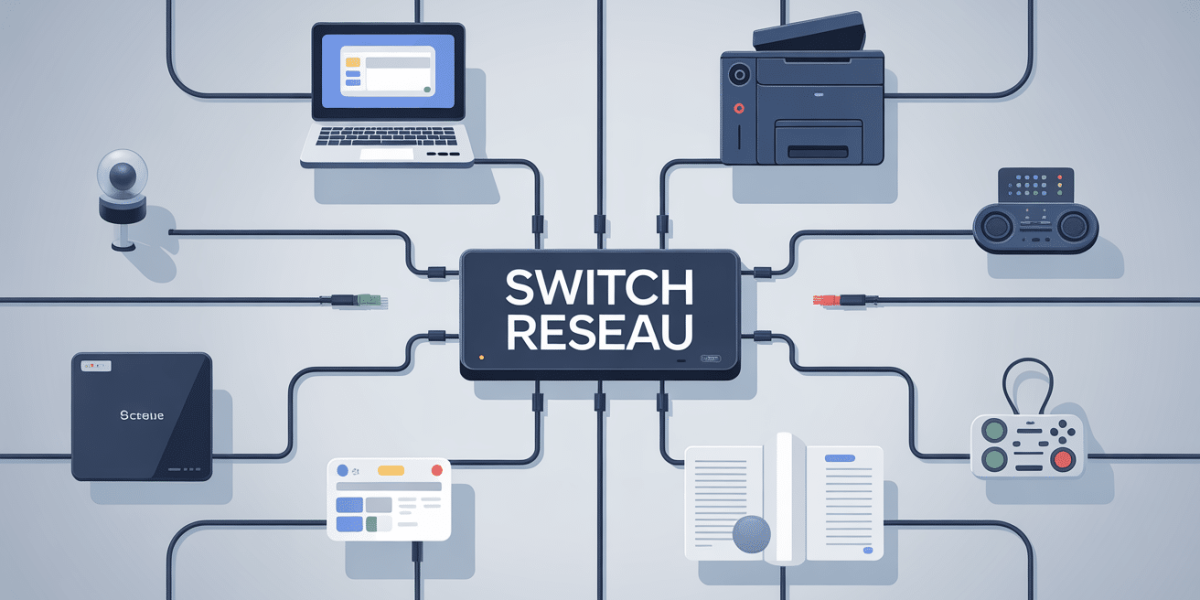
When there is a desire to connect several equipments to the home or to the company and the word "switch" appears, there is no reason to worry: this device plays the conductor, orchestrating communication between computers, printers or other materials, all without any confusion or traffic jam. In practice, it acts as the real core of traffic on a local network.
In concrete terms, a switch (also known as a network switch) connects several devices to the same local network (LAN) and optimizes data exchange between them. If one makes an analogy, imagine an ultra-efficient postal sorting: when a "package" arrives at its destination, the switch focuses on its label (the MAC address), and makes it reach the right box without sparing anywhere unnecessarily! This precise operation speeds up exchanges, limits computer collision problems, and generally offers more security and reliability than just a hub. In fact, even for a small office or a fireplace equipped with six to eight devices, some notice relatively quickly an improvement in fluidity, without unexpected microcuts.
What is a network switch?
When we consider connecting several stations together, the notion of switch comes back naturally, but nothing unaccessible in this: it is an electronic enclosure with 5 to more than 100 Ethernet ports depending on the range, which allows wired equipment to dialogue effectively within the same local network.
A specialist network trainer has entrusted that a well operated switch quickly becomes indispensable, even in a basic training room with many positions. This avoids congestion: each connected device sends and receives data without polluting others, because the switch does not transmit anything useful. A model of 8 ports covers most domestic uses, while schools or establishments can be oriented towards 24 or more ports. Some professionals believe that this greatly simplifies daily maintenance.
How a switch works: magnifying switch
The switch does not only physically interconnect the cables: it controls the packet circulation by applying the famous "commutation". As soon as a device transmits data (file, print...), the switch reads the destination MAC address and then delivers the package to the exact port. It thus avoids unnecessary broadcasting, which guarantees private exchanges between the parties concerned.
A few concrete benchmarks: a modern switch detects thousands of packages each second, automatically adjusts the speed of each port (Fast Ethernet, Gigabit), and often connects without any complicated setting. To visualize the advantage, on a network equipped with Gigabit switches, the flow increases to 1000 Mb/s, which allows the transfer of an HD film between two computers in just a few seconds (a striking difference for who works with large files).
Switch, hub, router: what differences and how to choose?

These three network equipment can easily be confused, especially when you start. Yet they do not perform the same functions or the same degree of logic: clearly distinguishing their role avoids buying mistakes and frustrations. Is it really useful to dwell on these differences? Clearly, yes in practice.
| Equipment | Central function | Network level | Transmission |
|---|---|---|---|
| Switch | Connects devices of the same local network (LAN); orient packages to the correct MAC address | Layer 2 (Data Link) | Selective transmission (commutation) |
| Hub | Connects the apparatus of a LAN; diffuses to all without distinction | Physical layer | Broadcast |
| Router | Connects different networks; manages Internet or other LAN | Layer 3 (Network) | Transmission according to IP addresses |
To give you an image: the hub acts like a megaphone that announces everything to everyone, while with the switch, it is a host agent that steers to the right port. The router is responsible for opening the door outside, i.e. accessing the Internet.
Another point to keep in mind: for a domestic need or TPE, a switch is sufficient to compensate for the lack of ports of an Internet box, while the router remains mandatory for connecting to the outside world.
What are the types of switches and how to choose well?
The wide choice of models can destabilize, especially if you discover the subject: managed, unmanaged, Layer 2, Layer 3... Yet each category responds to a concrete use, and there are practical benchmarks to find it, even without intrusive technical discourse.
Types of switches to know
Unmanaged switch (often mentioned "plug-and-play") is distinguished by its simplicity. No adjustment: we plug in and everything works. More 70% of current needs at home or in micro-activity are perfectly satisfied.
At the same time, the so-called "manageable" switch targets specific needs, much appreciated in the professional world: creation of VLAN (sub-networks dedicated to security or organisation), prioritization of certain uses (QoS), consultation of statistics, remote administration via web interface or cloud. Some SME networks can be managed from five posts, especially when security is the priority. A network expert indicated that the issue of VLANs is a regular issue in company safety audits.
- Layer 2: concentrates on basic switching, to circulate data within the same LAN.
- Layer 3: adds a routing component, to allow exchanges between different local networks (essential for multisite structures or data centers).
In practice, the majority of individuals favour an unmanaged model 5 or 8 ports (From 20–30 €). For a company with more than 10 employees or advanced needs, it is common to refer to a manageable switch Layer 2 or 3, with ISO/Qualiopi certifications, the first prices starting to 100 €.
What are the concrete benefits of using a switch?
As soon as the number of equipment exceeds two or three, the use of a switch naturally imposes as much for speed as for quiet management. Several observations emerge from the field:
- The striking improvement in network performance: slowdowns in free fall, even in the presence of many users. In a digital drawing workshop with eight connected PCs, the switch eliminates data collisions ("network collisions"), which was not possible with a simple hub. Some network technicians note a decrease in incident tickets just after installing a suitable switch.
- A real gain in safety: flows only circulate between the devices concerned, which seriously limits the risks of intrusion or listening on the LAN. For a company welcoming visitors, it is far from being anecdotal.
- Flexible management of the number of ports: 4 to over 100 ports commercialized, the rise in power without friction. Sometimes an administrator has to add a switch quickly to cope with the arrival of new posts, without reorganizing any existing ones.
- The ability to segment the network: Separate sub-networks (VLANs) are created to isolate services or activitiesideal option if a computer guest arrives on time, or to differentiate between personal and professional use.
A point that has been evolving for some years: most models offer simplified administration, combined with rapid technical support (from 30 €/day, hotline 24/24). This sometimes delays the use of an expert, and many users are satisfied with managing their own installation.
Examples of practical uses and contexts
Perhaps you are wondering about the interest of investment in your case? Here is a sample of real situations where the switch makes all the difference, even when the initial needs seemed relatively modest.
Domestic network: home-forgotten boost
In the family environment, between the Sacha game console, the TV box, a laptop PC and the network printer, there is a quick encounter with the limit of the four ports offered by the box. The addition of an 8 port switch enabled all these devices to be connected simultaneously, without significant latency, and ended the work of plug-ins to integrate the backup NAS. It is not uncommon for a family to realize this need on the occasion of a gaming weekend or in front of children's requests.
Small business or workshop
In a training workshop, it was observed that the slowdowns became the rule from five posts on a basic hub. Since the transition to a Layer 2 switch, time savings on transfers, security enhanced by the creation of VLAN to distinguish administrative and learners: these points are regularly raised during feedback from field experience. Several small structures opt for this type of equipment from the moment of creation, so as not to be limited a few months later.
Data center and evolving network
For the most imposing models (>48 ports), the logic wants them to be found among others in companies or data centers, where they manage dozens or hundreds of servers, with advanced functions such as port-mirroring (copying flows for supervision), or cloud administration. Again, some park managers stress the interest in anticipating growth: choosing an evolutionary switch rarely costs more than a few extra cables, but can avoid many headaches over the long term. Doubt on installation? Contact us for a personalized quote (We often find advice from a competent manufacturer).
To optimize the connectivity of your audio and network equipment, discover this complete guide to choose a three-way audio management card.
For optimal management of your connected equipment, discover how Netocentre, the safe school portal for all your digital needs can integrate into your network with a powerful switch.
To optimize your network connections while simplifying the management of your devices, find out how to successfully connect with Micro USB to USB-C: the keys for successful connectivity transition.
How to simply install a switch?
Good news: installing a switch is within reach, even without any technical baggage. It is sufficient to 10 min: connect the main box or router to the switch via an Ethernet cable, then connect the desired devices to the other ports. Field tip: labeling each cable from the beginning facilitates management, especially if the network expands later.
For those opting for a managed switch ("manageable"), access to an interface (often online or via app) gives the hand to create VLANs, prioritise certain users (video conferencing, security...), monitor consumption. Note: technical support provided by most manufacturers offers assistance 7 days/7, sometimes a 24-hour hotline for professionals. The major brands highlight their ISO 9001:2015 and Qualiopi certifications, which attest to the seriousness of the chosen equipment.
In case of doubt or desire to go further, there is a PDF guide for installation in a handful of steps, or possible accompaniment by dedicated chat. Sometimes a network technician from a training centre recommends taking a look at it, even with solid foundations!
Special FAQ network switch: the questions that are asked most often
Because each network configuration raises specific cases, here is a synthesis of responses tested in the field (and validated by many trainees over the years):
What is the difference between a switch, a hub and a router?
The switch sorts, then directs the data to the machine in a targeted manner; The hub is blindly "diffuse" throughout the park; the router manages the passage to the Internet and exchanges with the outside networks.
Which switch to choose for my company?
Below ten facilities, unmanaged is the most common. Above, or when it becomes relevant to segment, supervise, give priority to certain flows, it is better to steer towards a model managed Layer 2 or 3, by checking (of course) the presence of certifications, remote control, warranty. Many manufacturers offer simulators to refine the choice according to the size of the network and the expected level of safety.
Is installing a switch really complicated?
In plug-and-play mode, less than 10 min, everything works : direct connection, no configuration. To maximize security, however, it is advisable to change admin passwords and perform a firmware update if the switch is manageable. Useful clarification that a network expert will remember.
Does a switch improve security?
By restricting the intended recipients only, confidentiality is reinforced. Managed switches also allow fine control of rights and surveillance of suspicious behaviors on the network (ideal to detect early intrusion).
Need personalized help?
To discuss your project, get a first network diagnosis or quick quote: Request a network quote – response within 24 hours. It is not uncommon for a prior discussion to save time... and savings on the material to choose from.
Updated on 23 March 2026