
Published by: Élodie Maurel-Lescure — Writer specializing in literacy training
Editorial skills are not limited to the absence of faults. They are used to transform an idea, information or request into a message that is understandable, useful and adapted to its reader. Professional email, CV, report, memory, web page or transcript: better writing improves the effectiveness of the message and the credibility of the person signing it.
Contents
What Writing Skills Really Cover
Editorial skills combine the skills needed to design, organize, formulate and correct a text. They combine language proficiency with the ability to reason from the point of view of the recipient. A text can be grammatically correct while remaining confused if it lacks objective, hierarchy or context.
Test your writing skills
Answer the 6 questions, then confirm your answers to discover your result.
In the professional world, they are used to advance an action: getting an answer, explaining a decision, convincing a client, transmitting a procedure or reporting a job. At university, they help to demonstrate, argue and quote ideas rigorously. In daily exchanges, they limit misunderstandings and too abrupt formulations.
Write to be understood, not to impress
The quality of a text is first measured by the effort it asks the reader. Short sentences, precise verbs and a logical structure facilitate reading without impoverishing thought. Use a simple language does not mean being simplistic: you have to choose the exact term, then explain the jargon when it is indispensable.
A visible skill from the first writings
A recruiter, customer or colleague often makes an initial idea through an email or CV. Recurring mistakes, endless sentences and imprecise demands can weaken a message that is nonetheless relevant. A common figure indicates that 52% of HRDs exclude a CV with 2-3 errors. The rereading therefore becomes a professional reflex, not an optional finish.
The 9 editorial skills to develop
- Clarify the objective: know what the reader should understand, decide or do after reading.
- Know your audience: adapt the level of detail, tone and vocabulary to a client, manager, jury or general public.
- Structure your ideas: order information from the most important to the most detailed, with a legible plan.
- Be concise: remove repetitions, detours and forms that do not provide any information.
- Use a specific vocabulary: prefer a just word to a vague or ambiguous expression.
- Build fluid phrases: master syntax, logical connectors and reading rhythm.
- Popularize: explain a technical subject without distorting information or losing the reader.
- Treat presentation: aerate text, cut ideas and use consistent titles.
- Reread and revise: correct spelling, but also check the consistency, tone and usefulness of each sentence.
Language issues of the French Academy | Find the official answers to the current difficulties and questions of the French language.
These skills work together. An impeccable spelling does not compensate for a misorganized idea. Conversely, solid reasoning loses its strength if it is drowned in a dense text. Developing them gradually gives results more lasting than the search for a supposedly perfect style.
Moving from a useful draft to a convincing text
Prepare the message before writing
Before writing, note in one sentence the objective of the text and identify its main reader. Then list the three necessary information, then list it. For an email, start with the expected request or decision. For an article or report, start from the central idea, develop the arguments, and then finish with a clear conclusion or next step.
A simple rule helps to keep going: a paragraph deals with an idea. Two to three sentences are often enough to expose, illustrate and make the transition. Titles, lists and returns to the line are not only used to aerate the page. They tell the reader where to find the information.
Use punctuation as a guidance tool
Punctuation guides the reader's progress. The point sets an idea, the comma organizes close elements and the two points announce an explanation or a list. When a sentence requires too many commas, parentheses and embedded clarifications, it probably contains several ideas that deserve to be separated.
This quickly improves readability. It also helps to identify logical links between sentences: cause, consequence, opposition, example or conclusion. If the reader has to read a sentence to understand the relationship between two informations, the syntax often deserves to be simplified.
Revise in several passages
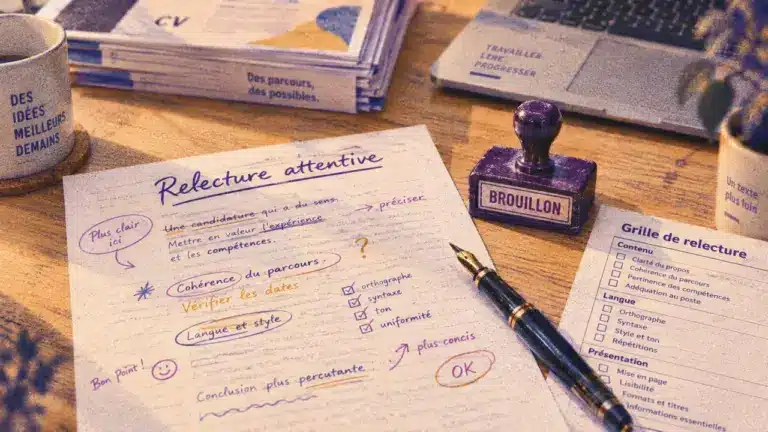
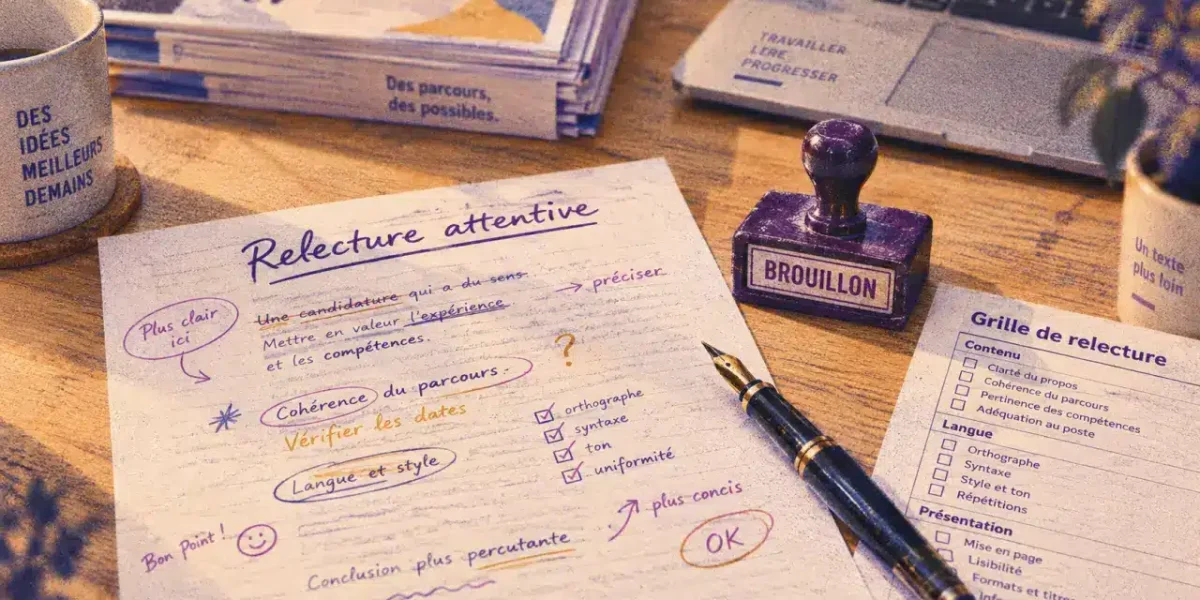
Rereading only once often leads to see only obvious mistakes. An effective revision separates tasks: first check the substance and order of arguments, then the formulations, finally the spelling, the chords and typography.
Reading the text aloud allows you to spot too long sentences, repetitions and artificial transitions. If possible, pass a few hours before the last reading. This distance helps to reread as a true recipient and detect passages that seem obvious to the author, but that are not obvious to the reader.
Concrete exercises for sustainable progress
Progress comes from a targeted practice. Writing more is useful provided you observe what works and what blocks. Choose a regular support, such as a logbook, a meeting summary, a professional publication or a reading note, then set a specific goal: shorten sentences, better introduce paragraphs or avoid vague words.
- Summarize an article or meeting in five lines, then in two lines. You work in synthesis and hierarchy.
- Reform a technical passage for a non-specialist. You train popularization and adaptation to the public.
- Compare a raw and a corrected version of your text. Identify each removal, displacement or accuracy added.
- Ask for a targeted return to a peer. Rather than « What do you think? », ask what he understood, what is missing and where he hesitated.
Keep returns received in a personal list: agreements that often come back, imprecise words, too long introductions or weak transitions. This list becomes a reviewlist adapted to your habits.
For a CV or motivation letter, focus on action verbs and concrete results. For a web text, start from the question the reader wants to solve. In both cases, check that each sentence contributes to the original target.
Choosing the right tools without delegating judgment
Correction and reformulation tools are useful for detecting errors or considering a different look. However, they are not aware of the exact intent, relational context or confidential information in your document. Their suggestion must remain a starting point: always reread the result and retain your voice.
| Resource | Main utility | Point of vigilance |
|---|---|---|
| Orthographic corrector | Identify faults, chords and shells | It can validate a correct sentence, but clumsy. |
| Reformulation tool | Explore a more concise or clearer sentence | Check for meaning, language level and nuances. |
| Grammar guide and site specialized in French | Understand a rule and enrich your vocabulary | Apply the rule to the actual text context. |
| Training or editorial support | Get a custom method, exercises and feedback | Choose a format related to its professional uses. |
Training is particularly relevant when writing often, producing complex content or gaining confidence in professional writing. It allows to work on concrete situations and to receive an external return.
However, the most decisive tool remains the careful review, guided by a simple question: Does this text really allow its reader to understand and act?
Valuing this skill in his career
Editorial skills deserve to be mentioned accurately on a CV, professional profile or interview. Avoid the isolated formula « good editorial capacity ». Prefer evidence of use: procedure writing, data synthesis, content creation, reporting, extension of technical information or coordination of written exchanges with clients.
This competence is cross-cutting. It supports project management, management, sales, marketing, consulting, human resources and studies. The selected examples must therefore show what you can produce and for what audience, rather than a general quality that is difficult to verify.
Knowing how to write clearly does not only mean using words well. It also shows that one can analyse a situation, prioritize information and respect the time of its interlocutors. In a CV, email or report, the quality of writing makes this skill visible from the front lines.
Updated on 13 October 2026