
Published by: Élodie Maurel-Lescure — Editor specializing in music training
Updated on 23 March 2026
The CRR Boulogne-Billancourt offers real opportunities for artistic development through recognized pedagogy, attentive teachers and an environment where everyone can reveal their potential. From initiation or in specialized courses, this conservatory accompanies young people and adults in their project, valuing individual and collective success through structured courses and a dense cultural life. This place focuses on the quality of State recognized diplomas and fully respect the rhythm of each student. It represents a solid springboard: whether it seeks to explore a new field or deepen its passion in a stimulating and inclusive setting.
Contents
What is the Boulogne-Billancourt RRC?

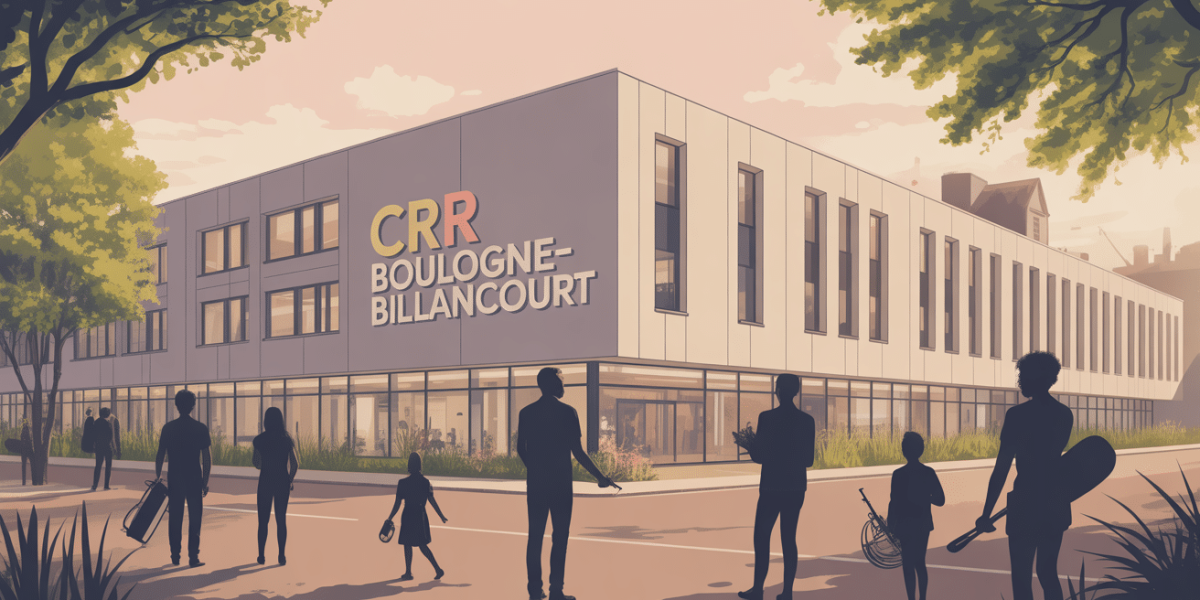
The Conservatoire a Rayonment Régional (CRR) de Boulogne-Billancourt, located at 22 rue de la Belle-Feuille, belongs to the circle of major French public institutions under the supervision of the Ministry of Culture. With its remarkable history and demanding supervision, it welcomes every year about 1,400 pupils passionate about music, dance and theatre. It is regularly observed that educational excellence and state-of-the-art equipment make it a major reference in Île-de-France.
If one had to remember a historical anecdote, the conservatory was born in 1959 under the sponsorship of Marcel Landowski and no longer expanded its reach. Today, with the Paris RRC and the PSPBB, an original top pole, it attracts a wide variety of profiles. Last point to be noted: information meetings frequently include: "Is the RRC diploma recognized nationally?" In other words, yes: the RRC delivers official degrees, a guarantee of credibility among professionals in the art world.
Status, accreditation and ministerial leadership
Establishment labeled and financed by both the State and the City of Boulogne-Billancourt, the RRC scrupulously respects national educational schemes: ministerial accreditation, compliance of cycles, close links with universities and structures such as the PSPBB, Sorbonne, Paris 8. A trainer recently mentioned that this institutional recognition always reassures families during orientation interviews: the quality and equivalence of diplomas are guaranteed throughout the course.
Some people sometimes think that the RRC is only addressed to Boulonnais: in reality, it welcomes students from all over the department, from Greater Paris or even further away, seduced by its curricula and its level of requirement.
Discover the curriculum: music, dance, theatre

From the initiation cycle, the RRC has chosen to structure courses adapted to each level and ambition, for three main sectors: music, dance and theatre. This "individualised journey" organisation is found in most of the specialist guides and is a concrete benchmark for comparing institutions or guiding their choice. Some professionals also believe that this net cutting greatly facilitates the integration of new entrants.
Organization in cycles – from leisure to excellence
The true strength of the RRC Boulogne-Billancourt lies in its ability to welcome both those who discover a discipline and those who seek a path of excellence. Teaching is organised into three cycles for each specialty. These include preparatory cycles for higher education (CPES) and CHAM/CHAD schemes.
For example, here are a handful of key markers to better find:
- Three cycles for each discipline: entry from 7 years in music, around 8 or 9 years in dance, access to theatre in general from 15 years
- Scheduled classes (CHAM/CHAD) from college: they allow a successful articulation between education and demanding artistic training
- Possibility of double course as music/general studies or dance/general studies
- Preparation for the entrance competitions of the PSPBB and the major music schools via CPES cycles and equivalent courses
Some students say that an admission to CHAM allowed them to enjoy an optimised schedule: 7-10 hours of artistic practice per week without sacrificing classical materials. This system attracts more and more families and, in practice, it makes the difference at the hearing for those whose artistic ambition is affirmed.
Specifications and Advanced Options
The RRC claims several brands of singularity that are not found everywhere: writing classes, ancient music, jazz, musical, contemporary or classical dance, theatre with pre-professionalization curriculum. One teacher recently admitted that many colleagues also work as members of national juries, guest artists or external stakeholders. Some students testify: "It's not always obvious to be admitted, but you feel really accompanied."
The "scene" dimension and collective work are at the heart of each journey: participation in ensembles, orchestras, performances, multidisciplinary workshops, masterclasses with renowned speakers. It is also noted that this exhibition to the public creates a valuable dynamic for personal and artistic evolution.
Services and student life
To become part of the RRC is never to be limited to classes: families and students discover a whole range of ancillary services, sometimes mentioned at open doors or in the parent space, which help to simplify everyday life and promote development. Some parents say that they were reassured in the first few weeks by the diversity of support and the richness of association life.
Media library, instrument rental, aids and association life
Here, students, teachers and even parents have access to a specialized media library – a resource appreciated to prepare an audition, discover repertoires or simply nourish his musical curiosity. In addition, the instrument rental service offers real support to avoid having to invest too quickly in expensive equipment: it is usually necessary to count between 30-60 € by quarter according to the instrument chosen.
Some practical points worth keeping in mind:
- Access to Municipal grants Department's support for costs
- Dynamic Associative Life (APEC for Parents, Student Office "BDE" for Graduates)
- Accompanying on specific needs: inclusion handicap, personalized school follow-up, tutoring
One question often comes up with families: « Is it possible to enter the CRR without prior experience in solfège or instrument? » In practice, yes: appropriate initiation classes and tests are provided, especially for younger children.
Good to know
I recommend that you do not hesitate to ask the question: it is possible to enter the RRC even without prior experience in solfeggio or instrument through initiation classes and tests adapted for the youngest.
Schedules, rhythms and school support
The schedules are designed to reconcile classical studies with artistic aspirations. Most courses take place in 8:30 to 8:00 weekdays, with an extension up to 22h for certain group rehearsals or workshops. On Saturday, the teachings extend to 8.30pm. It is interesting to note that during the holiday period, the reception remains accessible for most disciplines.
On average, a student in cycle 2 of music benefits from 4 to 8 hours of weekly lessons, plus workshops, collective projects, concerts, educational outings and meetings with artists. One speaker recently mentioned that this flexible organization allows students not to neglect group life.
Admissions, calendar, modalities
Incorporating the RRC requires a pre-emptive approach: every spring, families and candidates are rushing to obtain information about competitions, CHAM, auditions or CPES. The selection exists, but the accompaniment upstream helps each one to find the path that corresponds to it, whether it is beginner or already confirmed. One administrative officer stated that the teams are very careful to guide each candidate according to their level and aspirations.
Registration schedule and procedures
Admission procedures differ according to discipline, level and previous course. The launch date for the 2025 school year is set at Monday, 15 September. Pre-registration starts – as every year: in the spring (April-May), and it is better to anticipate: demand is strong! For specialised channels (theatre, CPES, etc.), a detailed dossier and a quick hearing are required.
Think about the essentials to organize your registration:
- CHAM/CHAD competition for high school students: aptitude tests followed by a motivational interview
- Access to the "specialised cycle" course possible on competition and file
- Key Contacts : general reception 01 41 31 83 44, school service 01 41 31 83 10
Tuition fees are adjusted according to the family quotient: for example, a family with a high quotient will pay about 1100 € per year for a full curriculum, but targeted grants and exemptions exist. Frequently heard question before the secretariat: "Does pre-registration ensure a place?" In practice, no: the selection takes place after hearing or analyzing the file. However, all applications are studied in a serene and caring spirit.
To compare pedagogical approaches, the Regional Conservatory of Rueil-Malmaison: artistic excellence and cultural life is also distinguished by his commitment to the artistic development of his students.
For a complementary vision of cultural institutions, discover the Paris-Saclay Departmental Conservatory: Artistic Excellence and Local Anchor.
Like the Regional Conservatory of Versailles Grand Parc: a cultural and educational pillar, the RRC of Boulogne-Billancourt offers diverse and demanding artistic formations.
Documents, regulations, downloadable brochures
The regulations, admission procedures and educational brochures can be downloaded online as a practical option when preparing their files or wishing to examine each step in detail. The advice that is often heard in the corridors (return from a parent's experience): read the rules of procedure as early as summer: it specifies rights, duties and the living environment, which helps to avoid disappointments at the beginning of the school year.
The FAQ dedicated to families and students is a real success among new entrants: it brings together practical details, standard planning and essential emergency contacts.
Agenda and cultural outreach
The RRC is above all a dynamic cultural life open to the city. Every month, there are concerts, shows, masterclasses, conferences organised in the establishment: 9,50 € or 6 € With the culture card, it is possible to attend professional quality performances. Some visitors say they come back "just for the emotion of the show". It can be assumed that this radiation helps shape the spirit of the house.
Events, concerts, shows and masterclasses
The CRR's cultural agenda is relatively rich: orchestras in residence, partner festivals, masterclasses with international artists... without forgetting the Youtube broadcast of many recordings (true source of inspiration and training for the students most involved). This eventual operation encourages the creation of a true "CRR community", where everyone becomes an actor. Some former students testify that it was during these shows that they experienced their greatest artistic emotions.
We often hear the following question: "Are events open to the public?" The answer is yes: subject to available places and often via reservation, families, schools and curious people can participate. It is during these representations that magic is played: each project becomes a founding stage in the career or personal evolution.
Highlighting successes and institutional outreach
The RRC of Boulogne-Billancourt is distinguished by the valorisation of its former students, past professionals or winners of national and international competitions. The conservatory's news and newsletters regularly show these successes, an indirect proof that training opens up to many options (education, stage, creation, cultural professions, etc.). According to various speakers, this dynamic contributes to the attractiveness of the structure.
In addition, the institutional partnerships – PSPBB, Universities, festivals, companies – ensure that educational and artistic openness is rarely matched at the regional level.
Practical information and contacts
The general reception is located at 22 rue de la Belle-Feuille, 92100 Boulogne-Billancourt. The establishment opens from Monday to Friday between 8:30 and 8:00 (up to 22h on Saturday, 9 a.m. to 8.30 p.m.. The administrative services follow this timetable and during the holidays, the reception works 9 a.m. to 8.30 p.m., with closure to 5pm Friday and 4pm Saturday.
For an answer on registration: The telephone reception is available at 01 41 31 83 44, and the school service at 01 41 31 83 10. Concert rates remain accessible to all – 9.50 € full price, 6 € with the culture map.
| Resource | Contact details/Information |
|---|---|
| Address | 22, rue de la Belle-Feuille, 92100 Boulogne-Billancourt |
| Home Phone | 01 41 31 83 44 |
| School telephone | 01 41 31 83 10 |
| School hours | Monday-Friday 8:30-20:00 (until 10:00), Saturday 9am-20:30 |
| Holiday hours | 9h-20h30 (closed at 5pm Friday, 4pm Saturday) |
| Concert rate | 9.50 € / 6 € (culture map) |
| Official website | www.crr-bb.fr |
To receive all news, registration openings or programming: consider registering for the official newsletter and downloading the annual brochure on the site (PDF format available). Some professionals recommend to inform early or even attend a concert or open house to feel the "big house" atmosphere. It can be seen that this makes the difference when it comes to choosing one's artistic orientation.
Updated on 23 March 2026