

Published by: Élodie Maurel-Lescure — Writer specializing in literacy training
To work the dictation in 6th, it is better to have a short text well corrected than a long page copied without understanding its errors. Here are three original texts, usable for free, with preparatory exercises and their corrections. They allow to review the chords, homophones and times of the story, adapting the difficulty to the needs of the student.
Contents
Choose a suitable dictation before starting
The 6th belongs to the Cycle 3 The student consolidates the learning of primary school while developing his language analysis. The following texts target skills worked at this level: chords in the nominal group, relationship between subject and verb, conjugation and spelling of common words. They are training aids, to be linked with the lessons studied in the classroom.
Training at the 6th dictation
Complete the sentence, check your answer and repeat as many times as you wish.
Correct answers: 0 out of 0 checked.
Start with the first dictation if the plural brands are still fragile. Switch to second to distinguish homophones and grant a past participation with being. Reserve the third to the work of imperfect and simple past. It is not necessary to do everything at the same meeting.
A dictation can reach 100 words, but this length is not an obligation. For a student who gets tired or loses the wire, dictating only the first sentences keeps the same grammatical objective without multiplying the difficulties.
Three texts of dictation with preparation and correction
Instructions for use: the paragraphs entitled « Text to be dictated » also serve as correction models. The student should therefore not look at them during the dictation. An adult can read them aloud; to work alone, the student can use a pre-prepared recording.
First dictation: the chords in the garden
Preparation: Observe words wet, silencer and leaf. Before dictation, put in plural « a small branch » and « a silent bird ». Then look for the subject of the verb in « The leaves cover the way ».
Text to be dictated: In the morning, the young students cross the college garden. The small branches carry shiny drops. Under the trees, wet leaves cover the path. A girl observes two silent birds. His comrades look at the grey sky, then they join their room. In the classroom, the open windows let in fresh air.
Corrected explained: we write « Small Branches » and « Silent Birds ». In the text, « small » and « brilliant » take the mark of the plural feminine, because they qualify respectively « branches » and « drops ». « Silent » keeps the same form to singular masculine and plural masculine. The subject of « cover » is « Wet leaves » : the verb therefore takes the ending -ent.
Second dictation: an exit and homophones
Preparation: review a/to, sound and and/or. Complete these sentences: « She... prepared his bag » ; « The doors... Open » ; « It works... the station ». Explain each choice before discovering the text.
Text to be dictated: This morning, Léa prepared her bag and notebook. She arrived at the station with her friends. The doors are open, but the train is still empty. Travelers got in a quiet car. Lea put her stuff by the window. She looks at the docks and thinks about the day that starts.
Corrected explained: the answers are « a », « are » and « to ». We can replace « a » by « had » and « are » by « were ». In « at the station »This substitution does not work. Past participants « arrival » and « mounted »employees with being, agree with their subject : Lea is to the singular feminine ; Travellers, plural female. In « Lea put her stuff down. », the supplement is placed after the verb : « placed » remains unchanged.
Third dictation: an adventure at the time of the story
Preparation: learn spelling from shore, thick and vigilance. Conjugate « Moving forward » Imperfect with « we »then « See » to the simple past with « it ». Both forms require special attention.
Text to be dictated: The vessel was moving slowly towards an unknown island. On the bridge, the sailors observed the cliffs while their chief remained vigilant. Suddenly, a cry sounds. The youngest saw a light between the rocks. All turned to shore. A silhouette appeared, then disappeared behind the trees. The silence now seemed thicker.
Corrected explained: « we are advancing » and « He saw » are the expected answers. In the text, the imperfect installs the decor or describes a situation: « Moved forward », « observed », « remained », « seemed ». The simple past presents the events that advance the story: « sounds », « Overview », « Turned around », « appeared », « disappeared ». Attention to « all » This pronoun takes over all the sailors.
Organize the session without blowing the answers
The preparation serves to understand the difficulties, not to memorize the whole text. First do the associated exercises, then check the answers. If a word remains unknown, explain its meaning and have its spelling observed before beginning.
- Read the entire text for the first time so that the student understands the scene and identifies the characters.
- Dictate in groups of senses, without artificially isolating every word. Announce punctuation and repeat quietly if necessary.
- Reread the entire text while the student checks for forgetfulness.
- Allow time for independent editing before showing the correction.
During the dictation, avoid pressing a silent termination to signal a plural. When reviewing, give a general instruction: « Check the subjects and their verbs. » The student learns an approach that can be reused in the classroom without depending on an index given by the adult.
Transforming correction into visible progress
Comparing two versions is not enough: one must understand why a form is correct. Ask the student to choose some mistakes, find the rule and write a new example. For « windows open », he may propose « doors closed » and explain the agreement to the plural female.
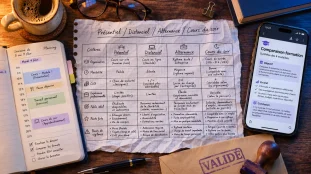
The error log can become a compass rather than an inventory of errors. Classify each hesitation according to its direction: « find the subject », « locate name », « recognize time » or « memorize the word ». If several errors point to the same direction, you have found the priority of the next session. This tracking avoids reviewing all grammar when only one procedure is missing.
To maintain a useful track, note after each workout the objective worked out, a success and a point to resume. A properly justified termination is already a step forward, even if other errors remain.
Print these resources, copy the selected text and its preparation to a document, then place the corrected text on a separate page. You can also use the function « Print » of your browser and select « Save in PDF format ». No separate file is required. Then take a sentence by changing the subject or number: this small transfer makes it possible to check that the rule is understood, and not only retained by heart.
Updated on 10 November 2026