Published by: Élodie Maurel-Lescure — Editor specializing in various
The second stage is a professional observation sequence for general and technological second-level students. Mandatory, it takes place for two weeks at the end of the school year, from 15 to 26 June 2026. Its aim is not to immediately choose a profession, but to discover a working environment, its activities and its codes.
Contents
What is the real purpose of the second stage?
This immersion allows you to leave the usual school setting to observe the operation of a company, an administration, an association or another host organisation. The student discovers sometimes unknown trades, exchanges with professionals and better understands what lies behind a job title.
For many young people, the course offers a first benchmark before the future choices of guidance. It can confirm an interest in a sector, but also change an idea. Not appreciating an observed activity is already useful information. The challenge is to develop his curiosity, not to succeed in a job interview or to produce a job comparable to that of an employee.
Observe, question and link experience to courses
A student can follow a tutor, attend meetings if the framework allows, discover professional tools, observe public reception, logistics, manufacturing, management or teamwork. Some simple tasks can be assigned to him, under supervision and in accordance with safety rules. The observation course never replaces the work of a professional.
It is useful to prepare some questions: what studies should be followed? What does a typical day look like? What skills matter most? What are the difficult aspects of the job? The answers help to link the subjects studied in high school, the specialties envisaged and the reality of the field. The student may also note skills that he did not suspect, such as organization, listening or ability to work as a team.
Duration, agreement and exemption situations
The second stage two consecutive weeks and covers approximately 560,000 pupils each year. In accordance with the arrangements provided for, it may also be divided into two periods. Before departure, one Internship Agreement must be established between the school, the host organisation, the pupil and his or her legal guardians when he or she is a minor.
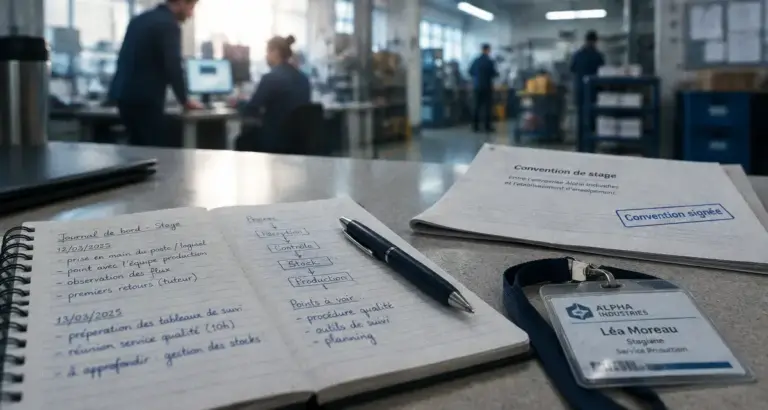
This document sets out in particular the dates, timetables, conditions of supervision, planned activities and contacts to be reached in case of problems. Immersion should not begin without a signed agreement. The latter supervises the student's presence in the structure and specifies the responsibilities of each.
Exemptions exist in certain specific cases
The traineeship is compulsory, but an exemption may be granted when the pupil participates, over the same period, in a cohesion stay or in a mission of general interest of the Universal National Service, in European or international mobility, or in certain school trips. The process is not alone. The student and his family have to get closer to the high school to check the situation and know the required proofs.
In the event of health problems, disabilities, transport constraints or special family circumstances, the senior teacher or management team must also be notified promptly. The establishment can support the search for a suitable solution, for example by examining reception possibilities or travel constraints. A material obstacle must not lead to giving up without having asked for high school.
Finding a business without relying solely on its network
The search requires an early start. Start by defining two or three realistic paths: a field that attracts the student, a place accessible from home and a structure that can accommodate a young observer. A small business, a business, a town hall, a media library, a firm, an association or a public service can offer a rich experience, even without « great name » on the Convention.
Use offers and multiply targeted applications
The national platform 1 student1stage allows you to consult second-hand internship offers and to facilitate contact with host organisations. Companies may also submit tenders. In 2024, 64,000 tenders were submitted. The number was 8,000 in 2025, while 10,000 offers were targeted in 2026.
A short and personalized application is more effective than an identical message sent to 20 recipients. It must specify the class of the student, the desired dates, the sector concerned and the reason for the request. A simple CV can complete the message: contact information, training, interests, school skills or extracurricular activities. If no answer comes, a polite recovery a few days later is quite possible.
- Identify structures within a transport compatible radius.
- Prepare an application message of a few lines, without faults and adapted to the recipient.
- Ask for advice from the principal teacher, guidance counsellor or school life.
- Plan several tracks instead of waiting for a single answer.
- Keep the responses received and note the steps already taken.
Searching becomes more difficult when the criteria are too rigid, such as a high demand area, a remote address or dates that cannot be changed. Slightly widening the perimeter, considering a different size structure or observing a neighbouring trade can reduce pressure while maintaining the interest of the internship. A student attracted to the care can discover the reception of a medical centre. A video game enthusiast can observe communication, computing or management in a local company.
What to do when no answer comes?
Not getting an immediate response is common and does not reflect a lack of motivation. Not all structures can accommodate minors, some have already filled their places and others do not have a guardian available. The difficulties in high school should be reported quickly rather than waiting for the last days.
High school accompaniment counts as much as personal contacts
The second stage should not depend solely on the family network. Educational teams can direct students to offers, propose partner organisations, reread an application or encourage less obvious leads. This support is particularly important for pupils who are far from the activity centres, those from the priority neighbourhoods or those who do not have professional contacts in their surroundings.
By 2024, 70 per cent of students had signed an internship agreement. This figure reminds us that it is necessary to anticipate, but also that research is gradually being built. Parents and students should exchange regularly with the institution on the steps taken, the responses received and any refusals. The school can then adjust its advice rather than intervene only when the date approaches.
Prepare well the two weeks of observation
Une fois la convention signée, l’élève peut contacter son tuteur pour confirmer l’heure d’arrivée, la tenue attendue, les règles d’accès et le matériel éventuel. Arriver quelques minutes en avance, saluer les personnes rencontrées, écouter les consignes et demander l’autorisation avant d’utiliser un outil professionnel sont des attitudes simples qui facilitent l’accueil.
Tenir chaque jour quelques notes facilite le bilan demandé par le lycée : activités observées, métiers rencontrés, vocabulaire nouveau, compétences repérées, moments surprenants et questions restées ouvertes. Ce carnet de bord évite de tout reconstruire de mémoire à la fin du stage. Il permet aussi de comparer les attentes de départ avec ce que l’élève a réellement découvert.
- La veille, préparer l’itinéraire, une pièce d’identité si nécessaire et les coordonnées du tuteur.
- Le premier jour, se présenter clairement et demander quelles sont les règles à respecter.
- Pendant le stage, observer les métiers et l’organisation : horaires, collaboration, outils et relation avec les clients ou les usagers.
- À la fin, remercier l’équipe et prendre le temps de faire un bilan personnel.
Le meilleur résultat n’est pas forcément une vocation trouvée en deux semaines. C’est une vision plus concrète du monde professionnel, des questions mieux formulées et une première expérience que l’élève pourra réutiliser pour ses futurs choix d’orientation.
Mis à jour le 20 octobre 2026