
Published by: Élodie Maurel-Lescure — Editor specializing in various
Choosing a ceramic oven does not mean looking for the highest maximum temperature. The model must correspond to your land, your enamels, your production rate, the energy available and the place actually accessible in the workshop. Between a small electric oven to start, a gas oven to explore the cooking atmospheres and a more demanding wood oven, uses and constraints change significantly.
Contents
A ceramic oven, for what cooking and what temperatures?
A ceramic oven sustainably transforms clay shaped by a controlled temperature rise. First, it is used for the cooking of slurry, which makes the pieces manageable and prepares them to receive an enamel or an engobe. It then allows the cooking of enamel, whose temperature depends on the soil used and the desired finish.
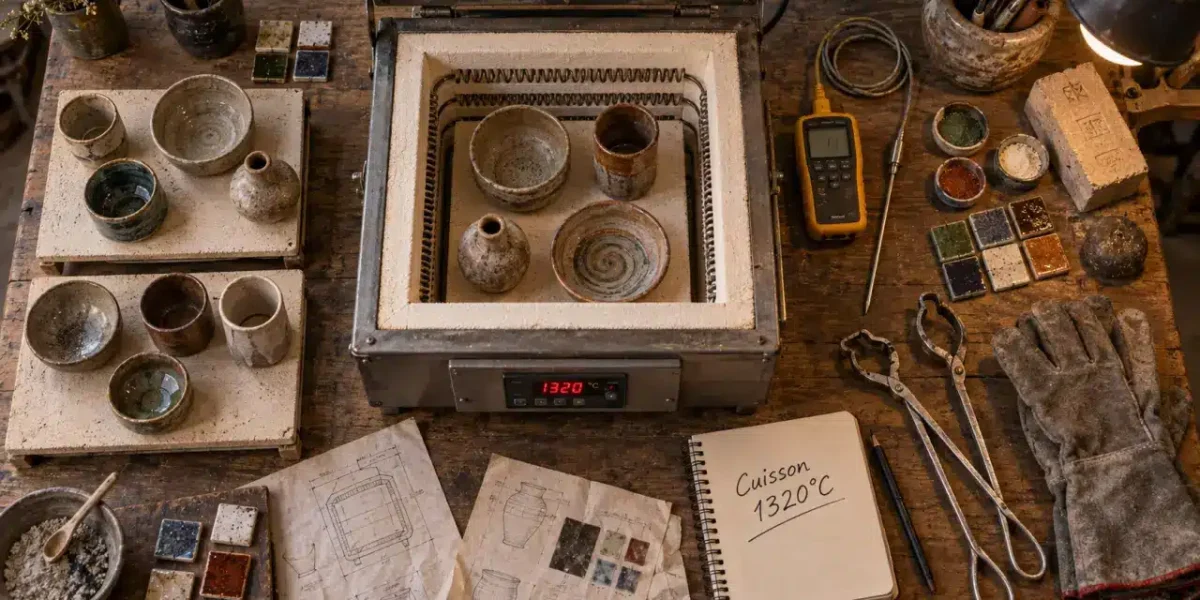
The maximum temperature therefore remains a determining criterion. Some ovens reach up to 1320° C, a range suitable for high temperature cooking. However, it is not necessary to systematically choose the most powerful model. A low-temperature land-based practice does not require the same performance as regular sandstone or porcelain work. Check the cooking temperature recommended by the manufacturer of your materials and keep a margin suitable for your future use.
Regulation counts as much as heat
The success of cooking also depends on the stability of the climb, bearings and cooling. A programmable controller allows you to repeat a cycle and modify the parameters after observing the results. The thermocouple, often associated with a type K probe, measures the temperature inside the chamber. This measure is particularly useful when the parts are thick, enamelled or produced in series.
An oven is not limited to heating a room. A perfectly turned piece can split if its residual moisture is not evacuated slowly enough. A well prepared enamel can also flow if the bearing is poorly controlled. Upon purchase, examine the programme repeatability, ventilation and the possibilities of monitoring cooking. These criteria protect your work and make it easier to adjust over the furnaces.
Electric, gas or wood: compare the three approaches
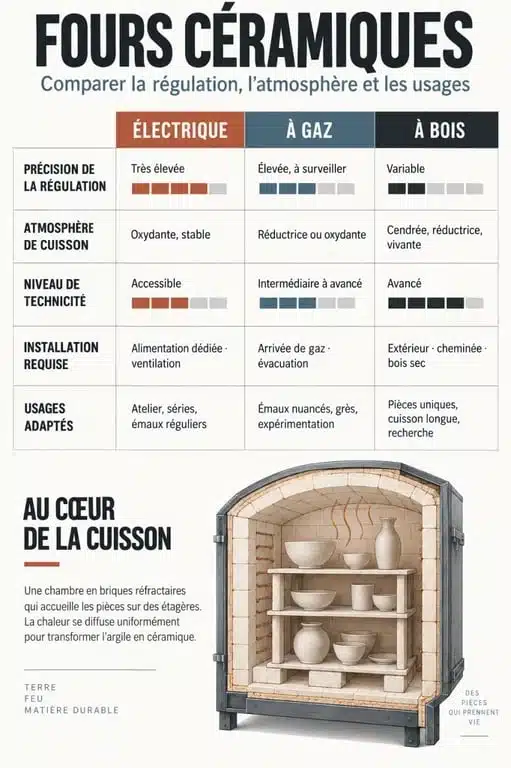
The type of energy influences the installation, the comfort of use, the rendering of surfaces and the necessary learning time. No technology is superior in all workshops. Each solution responds to a different way of producing and driving a cooking.
Understanding the risks of inorganic fibres at work | This INRS dossier presents the available knowledge on fibres other than asbestos and the measures to prevent associated chemical risks.
| Type of furnace | Main assets | Points of vigilance | Appropriate use |
|---|---|---|---|
| Electrical | Precise regulation, accessible grip, reproducible cooking | Power supply, resistance monitoring | Leisure, individual workshop, school, small and medium series |
| Gas | Specific cooking atmospheres, dynamic temperature rise | More technical installation and conduction, essential ventilation | Craftsman wishing to explore cooking effects |
| Wood | Expressive results, strong interaction with flame and ashes | Long cooking, fuel, outdoor space and required know-how | Experimental practice or specialized workshop |
The electric oven, the most direct choice
The electric oven easily integrates into a regular practice. Its twisted resistors heat the chamber, while a controller manages the selected program. It is suitable for learning, reproducible enamel cooking and workshops that want to limit the number of variables. Depending on the model, power supply can be provided in 230V single phase or 400V three-phase. This point must be checked with the existing installation before any control.
Gas and wood: more technical driving
The gas oven and wood oven attract the less uniform character of their cooking. Flame, oxygen and, for wood, ash, contribute to surface effects. This diversity requires more active driving and a suitable installation. These solutions are not only chosen for their aesthetic rendering. They require technical control, efficient ventilation and an environment compatible with the heat released.
Dimension the oven according to your workshop and production
The capacity, expressed in litres, must be assessed from your usual parts, not the number of objects you plan to produce one day. Measure the height of your vases, the diameter of your dishes and the frequency of your furnaces. Too small a volume requires repeated cooking. Conversely, a too large model can be badly adapted if you rarely cook with a reduced load.
Opening, congestion and power supply
Vertical opening facilitates the loading of many small pieces spread over several levels. Frontal opening gives more progressive access to blasting plates and can simplify the handling of bulky shapes. In both cases, provide for the area of circulation in front of the oven, its weight, the clearance around the walls and a stable soil.
Before purchasing, ask for the power, the type of connection required, the external and internal dimensions, and the installation conditions. Have the electrical installation checked by a professional when the power or the transition to the three phases requires it. In an existing premises,available energy can weigh more in the decision than a comfort option.
Three profiles to avoid a poorly calibrated purchase
- Home starter: Focus on a compact, programmable and compatible electric oven. Keep sufficient space to learn how to load plates and organize parts.
- Production workshop: look for a consistent capacity with your series, reliable regulation and easy access to spare parts. The ease of maintenance counts as much as the useful volume.
- School or shared place: focus on robustness, legible controls, clear operating procedures and planned maintenance monitoring. Several users must be able to apply the same settings.
Accessories that secure the furnace
The oven alone is not enough to organize a clean and sustainable cooking. The baking plates and the cooking supports create floors and allow to exploit the volume without overlaying the parts. Choose refractory elements adapted to the intended load and keep them clean. A glued drop of enamel can damage a plate and immobilize a piece.
- Refractory plates and supports: They structure stacking and stabilize objects.
- Refractory bricks: They may be used for certain thermal adjustments, repairs or adjustments.
- Ceramic fibre and refractory glue: they are intended for targeted isolation interventions, according to technical recommendations.
- Thermocouple: This room must be monitored because it is directly involved in the temperature measurement.
The props represent a budget. As a benchmark, a cooking medium can cost between 7,00€ and 10.00€, a refractory glue is indicated at 12,00€, a ceramic fiber plate from 40 x 50 cm to 20,00€, and a refractory ladder from 30 cm to 30,00€ in single version or 35,00€ in double version. Their compatibility with the diameter and interior format of the oven remains a priority over the unit price.
Buy, install and maintain without bad surprises
Compare the data sheets with the same attention as the prices: maximum temperature, useful volume, power supply, type of opening, programmer, guarantee, availability of resistance and quality of service after sale. A 200-litre Raku oven is displayed at 950.00€, but this price does not replace an overall estimate. It must incorporate the necessary transport, installation and accessories.
Install the oven in a ventilated space, free of any flammable material and easy to monitor. Do not place it in a crowded passage or against a wall without respecting the manufacturer's recommendations. During cooking, avoid unnecessary openings. Thermal shock can compromise parts and opening exposes to dangerous heat.
Finally, schedule a regular interview. Inspect the door, joints, plates, visible resistors and connections according to the manufacturer's instructions. Remove the enamel residue, replace the worn elements with suitable parts and note your cooking curves. This monitoring transforms the first tests into a reliable method and extends the service life of your pottery oven.
Updated on 8 September 2026