

Published by: Élodie Maurel-Lescure — Editor specializing in music technology training
Updated on 23 March 2026
Starting as Sound engineer, it is to embrace a profession where each trajectory is singular, with salary which can sometimes surprise by route, region or status. Based on the realities of the field and my experience in creative accompaniment, I offer you a concrete look at the expectations of remuneration, the paths of entry into the profession and the resources to highlight your profile. The objective? Help you make an informed choice, aligned with your artistic desires and lifestyle.
Summary of key points
- ✅ Sound engineer salaries vary widely depending on experience, status and location
- ✅ Training and networking are essential to progress in the profession
- ✅ The choice of status (intermittent, freelance, employee) influences financial stability
Contents
A sound engineer's salary: what you can really expect in 2025

What does a sound engineer paycheck look like in France today? Many juniors start between 1 766 € and 2 400 € Gross per month (approximately 25,000 to 31,000 € Gross per year). Wages rise sharply with experience and recognition, between 3 500 € and 5,500 € Monthly grossup to and including 90 000 € Gross for reputable profiles. The sector of activity, status (intermittent, freelance, employee) and level of specialization weigh heavily in the balance. Many question the risk of intermittentity and the quest for stability. Viable or risky? How best to negotiate? These are frequent questions among emerging professionals.
| Experience/Status | Gross salary (monthly) | Gross Annual | Freelance Journal Tariff |
|---|---|---|---|
| Beginner (employee) | 1 766 to 2 400 € | 25,000 to 31,000 € | 200 to 350 € |
| Experienced (5-10 years) | 3,500 to 5,500 € | 40,000 to 72,600 € | 300 to 800 € |
| Paris (average) | 4 500 € | ~54 000 € | 350-800 € |
| Province (average) | 3 000 € | ~36 000 € | 200 to 600 € |
| Switzerland (reference) | 7 500 € | ~90 000 € | – |
In practice, an engineer's public sector employee starts around 1 950 € Net. In the private sector, it's a completely different story: everything depends on the number of projects, the ability to sell and the address book. Some combine several missions to secure income. In Paris, the difference with the province can approach 1,500 € per month. On the freelance side, the daily rate climbs fast as soon as a professional makes a name or supports major events. A recruitment officer from a large hall also explained that she saw the differences between Paris and the rest of France every year.
Presentation of the trade and missions

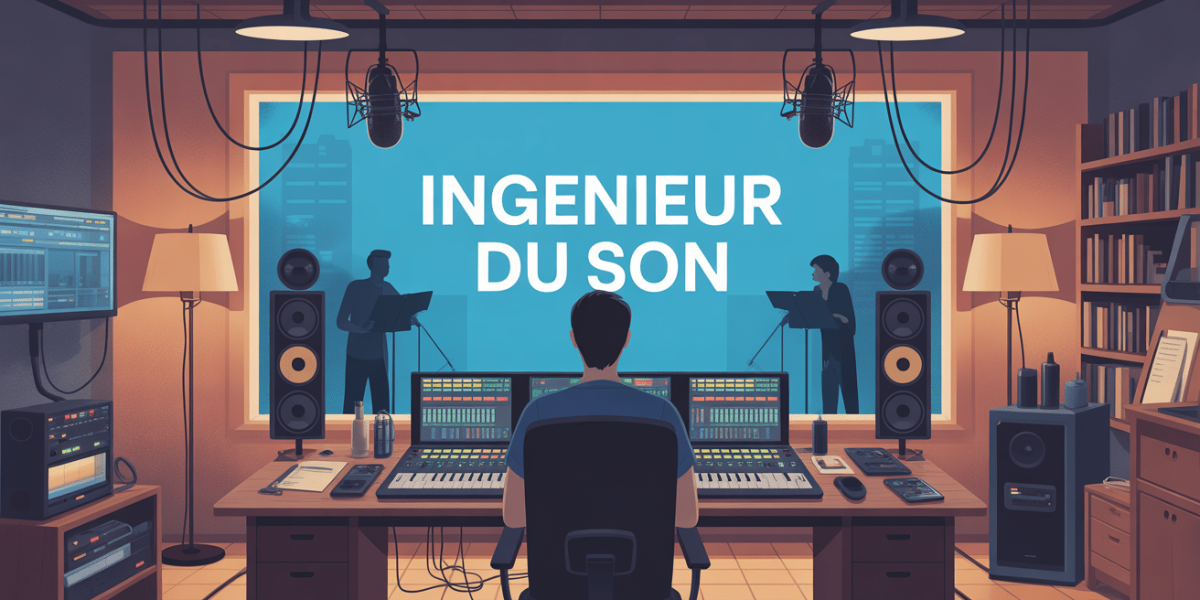
Every day, the sound engineer navigates between technique and creation. It is not uncommon to meet him in a studio as well as in a concert, on TV sets or even on film shoots. Some argue that this diversity is one of the real riches of the profession.
Definition and main tasks
Guaranteeing the quality and fidelity of a sound take, from recording to mixing, is the core of the profession. The tasks include:
- Installation and adjustment of all audio equipment (micros, consoles, software, acoustics...)
- The conduct of various recordings: music, dubbing, noise, atmospheres
- Mixing, post-production and latest settings (mounting, effects, mastering)
- Technical adaptation depending on whether it is live, studio or audiovisual broadcasting
Sometimes a professional moves from close proximity to musicians in a club to managing a pressurized radio set, sometimes in the same week. A trainer recently recalled: it's better to love changing decor and keeping a bit of energy in reserve, this job doesn't leave too much room for monotony!
Sectors of activity and specialties
The field of exercise of sound engineers is relatively varied:
- Recording music studios
- Live shows: from tours to festivals to theatre
- Television, radio, cinema, post-audiovisual production
- Event and web (streaming, conferences, etc.)
Some specialize in mastering, others specialize in live sound. The use of digital technologies increases every year. Mastering Pro Tools or Ableton Live sometimes becomes a real sesame on some projects, according to the returns of recruiters from the sector. A young pro recently shared that a Logic Pro certification had enabled him to access unexpected opportunities.
Essential courses, diplomas and training
To the question "what studies will open the most doors?", one can answer that there are well marked paths ... but not exclusive. The sector attaches importance to both initial training and practical experience, provided that it can be quickly operational.
Bases: BTS, pro licenses and software certifications
The BTS Métiers du Son is one of the most recognized training courses to start. However, this is not the only lead. Professional licenses (here, Sound and Image Techniques), Audinate certifications, or intensive courses of about two months of Sound Academy type: each option develops different assets.
It's best to remember a few points:
- Many self-taught people enter the profession, provided they can show their skills or have a motivating network
- Practical certifications (Pro Tools, Logic, Ableton) attract employers, in particular in studio or for audiovisual purposes
- Continuing training becomes essential as the tools evolve quickly (e.g. the digital transition or the arrival of AI)
A participant in an intensive session recently told me: "I don't have a long degree, but knowing Cubase has allowed me to take up a position as manager at several small festivals." How the diversity of profiles ends up paying!
Good to know
I recommend you stay up to date with the new digital certifications and tools, as they often open more doors in this evolving business.
Importance of network and field experience
However strong it may be, no training will replace learning on the alive. We sometimes meet professionals for whom the first year of chaining internships, small pills, and voluntary associations was decisive. It is usually these contacts that make snowballs to pick up his first true missions. Moreover, some managers regularly stress the importance of self-help at the beginning.
Salary grids and variations: what the figures really say
Having benchmarks, especially before negotiating a contract, remains essential. There are significant differences in the sound engineer profession, reflecting the variety of paths and opportunities that arise – it is also noted that volatility often questions candidates.
Salary per experience, status and location
For the first year, the salary is around 1 766 € Gross (in the public). After five years, a threshold is crossed and the range is regularly reached 3,500 € 4,500 € Gross/month, especially in the Paris region. It is noted that in the live sector or for some premium projects, the most experienced may target 5 500 € or more each month.
Localization has a very concrete impact:
- Paris : about 4,500 € Gross/month
- Large cities : between 3,000 € and 4,000 €
- Province : in general between 2,500 € and 3,500 €
If a few routes come out of the lot, this trend can be found in most surveys by INSEE or industry experts.
Intermittent comparison, freelance, employee
Intermittance remains the norm in the profession. Many describe a year of alternation: periods of calm and very active months for pay. On the freelance side, the daily rate range varies between 200 € and 800 € (depending on project, network or reputation). But it is often recalled in pro networks: the most regular ones benefit from an advantageous word of mouth. For employees in the national media or in the public service, stability attracts a fixed base: 1 950 € to 2,400 € Net at the beginning of a career, to which sometimes additional bonuses come. One HR official recently reported that these levels of security attracted irregularity-laden profiles.
| Status | Gross starting monthly | Experienced gross monthly | Notes |
|---|---|---|---|
| Intermittent | 900 to 2,500 € | 3,000 to 6,000 € | Seasonal, variable, hollow periods |
| Freelance | 1,500 to 2,800 € | 4,500 to 7,000 € | Rates according to project (200-800 €/j), administrative burden |
| Employee | 1 766 to 2 400 € | 3,000 to 5,500 € | Security, scheduled evolution |
Professional status, intermittentity and financial stability
Choosing one's status often juggles the desire for freedom and the need for security. Many move from one diet to another depending on the project or the hazards of the market.
Intermittent diet: explanations and pitfalls to avoid
The disqualifying status of the performance entitles it to a specific compensation (Pôle Emploi Spectacle) if the threshold of 507 hours/year is validated. Relative security during the hollow months, especially if one juggles well between planning management and administrative procedures (declarations of employment, attestations, etc.).
Better keep in mind than:
- Low activity periods (summer, "hole" between two large dates) are the rule rather than the exception
- Compensation shall be paid only on the condition that the quota for hours has been validated each year
- Pay is still moving, and sometimes missions fall at the last minute!
Benefits, constraints and alternatives (employee, independent)
On the wage side, wage growth follows a more linear logic. Long contracts also offer health and mutual coverage. For the self-employed, the main thing remains the choice of tasks and the adaptability of tariffs, but social protection is to build itself (USSAF, VAT...). Some people then rely on a "mix": basic CDI for security, supplemented by freelance missions according to the opportunity. A sector accountant recently told us that he often advised this hybrid assembly to those who want the best of both worlds.
As with the sound engineer trade, understand the variables that influence the community manager pay in France: grids, evolution and prospects makes it possible to better understand professional and financial opportunities.
Similar to the observed changes in pay driver VTC in 2025 numerical realities and variations according to statusThe income of a sound engineer depends heavily on his/her experience, specialization and place of exercise.
Just as for the sound engineer trade, understand the variables that influence the incomes of other professions, such as the salary clerk in 2024: figures, prospects and realitiescan offer valuable insights into market dynamics.
Employment prospects and career development
The sound engineer often explores various sectors, he has to be flexible and responsive in order to achieve the most attractive missions. It is not uncommon to see brilliant technicians changing fields over the years.
Key enabling sectors and employers
Opportunities are mainly found in live performance, event (including sports), audiovisual production or media broadcasting. Among the most sought after employers are:
- Recording studios, national scenes and major festivals
- Post-production companies, TV & radio media
- Event structures, major audiovisual groups
Many recruitments are concentrated in Paris, but some regions now have a good dynamic, such as the Greater East in cinema. It is often understood that the capital offers almost three times as many missions in intermittance, all specialties combined.
Opportunities, conversion, opportunities for change
After about ten years, a real specialization becomes more and more frequent: sound conductor, technical director, or even trainer. Some start in the artistic direction, production or even export to international (Switzerland, Canada). Regular training and new certifications increase the bargaining space. For example, an engineer who became a training coordinator explained that she had been able to negotiate a significant increase following a new technical certificate.
Evidence and concrete examples: the reality of the field
Sometimes it is the stories of everyday life that best inform the reality of the profession. One of my intermittent contacts recently testified: € and others where I was displacing 4,000 €. But over the course of the year, this is balanced." Many complement their activities with teaching, room management or freelance collaborations to protect their standard of living. A conductor told me that he had taken two years to stabilize his turnover, the time to get out of the "precarity of the beginner".
Impact of training and initial experience
Whether you have obtained a BTS or received training in a few months, the threshold of 2 000 € Net is rarely reached for two or three years. Sometimes more if the network "takes" slowly! A TV channel manager recalled that the first big deals on events or directs could change everything overnight, some saw their pay double in the following season.
Tariff negotiations: tips and policy space
Several engineers share this advice: start each mission with a detailed estimate, never neglect the preparation or post-production time when setting your rate. Regular customers appreciate this transparency and are more willing to retain a reliable professional. This may seem intimidating at first, but over time, negotiations become (almost) routine. An event site manager recently slipped that her most faithful technician was also the most rigorous... and best paid of the team.
Useful resources: simulators, FAQs and tools to go further
Need to estimate your future standard of living or adjust your approach when negotiating? Many tools are available to make it clearer and to make informed choices.
Simulators and calculators online
Sites such as Jobted.fr, Indeed or Pôle Emploi offer raw/net calculators designed for intermittance as for freelance, and regularly updated according to the region. It is recommended to do one or two simulations before accepting a contract or imagining a conversion. A school worker told me that her students used these tools systematically before they went on internship.
FAQ, guides and contacts
Other practical and accessible resources include:
- FAQ on the negotiation and management of the intermittent regime (Pôle Emploi Spectacles, syndicats spécialisés)
- Downloadable salary tables, illustrated trade guides, video testimonials (HelloWork, Indeed, GRIM Edif...)
- Directory of schools and training courses to deepen or reorient
- Updated job offers and interactive map of employers by region
No route really looks like itself, but taking the time to inform (without falling into the anxious self-comparison) helps to take the step with more serenity. If some points remain blurred, do not hesitate to use a simulator or ask your questions to a professional, this remains an excellent starting point – without any obligation of course!
Updated on 23 March 2026