
Published by: Élodie Maurel-Lescure — Writer specializing in training in Event Organization
ISO 20121 certification confirms that an organisation has a responsible management system applied to its event activities within a defined scope. It does not just reward an event « Green » It assesses how environmental, social and economic issues are identified, managed and improved. To obtain it, it is therefore necessary to organize responsibilities, put commitments into practice and keep verifiable evidence.
Contents
What certification guarantees — and what it does not guarantee
Published in June 2012, ISO 20121 is an international standard dedicated to responsible event management. It provides a framework for integrating sustainable development into decision-making: choice of a place, procurement, travel, working conditions, accessibility or relations with local actors.
Test your knowledge of ISO 20121 certification
Answer all six questions and then confirm to discover your score and corrections.
The certification covers a management system within a specific perimeter. It does not mean « zero impact »neither carbon neutrality nor automatic compliance with all regulatory obligations. An organisation must identify the applicable legal requirements and organise their inclusion; the certificate does not replace this work.
The approach concerns agencies, fair organizers, festivals, sports competitions, communities, places of reception, caterers and technical providers. A small structure can engage: the organization of the system must remain adapted to its activities, resources and challenges.
Before communicating, check what is actually covered: an activity, a site, a series of events or a wider perimeter. A certificate limited to an activity does not allow for the presentation of all the company's services as certified.
Choose the level of recognition that is useful to your customers
Apply ISO 20121 and obtain independent certification are two separate decisions. The standard provides several ways to demonstrate compliance. The choice depends in particular on the expectations of the clients and the level of confidence sought.
| Modality | Who evaluates? | Point of vigilance |
|---|---|---|
| Self-reporting | The organization itself | It must be able to support its assertions; This is not an independent certification. |
| Confirmation by an interested party | A client or actor with an interest in the organization | Recognition depends on the framework and expectations of this part. |
| Third party certification | An independent body | The audit and certificate cover an explicitly defined scope. |
To respond to a call for tenders, start by reading the exact requirement: is a structured approach requested, evidence of shares or a certificate issued by a third party? Certification can enhance the credibility of the case and facilitate the buyer's assessment, but it does not guarantee the award of a contract.
Its interest is also measured internally: better distributed responsibilities, shared purchasing criteria and exploitable feedback. To convince management, link the process to concrete difficulties, such as urgent CSR requests or data scattered among several providers.
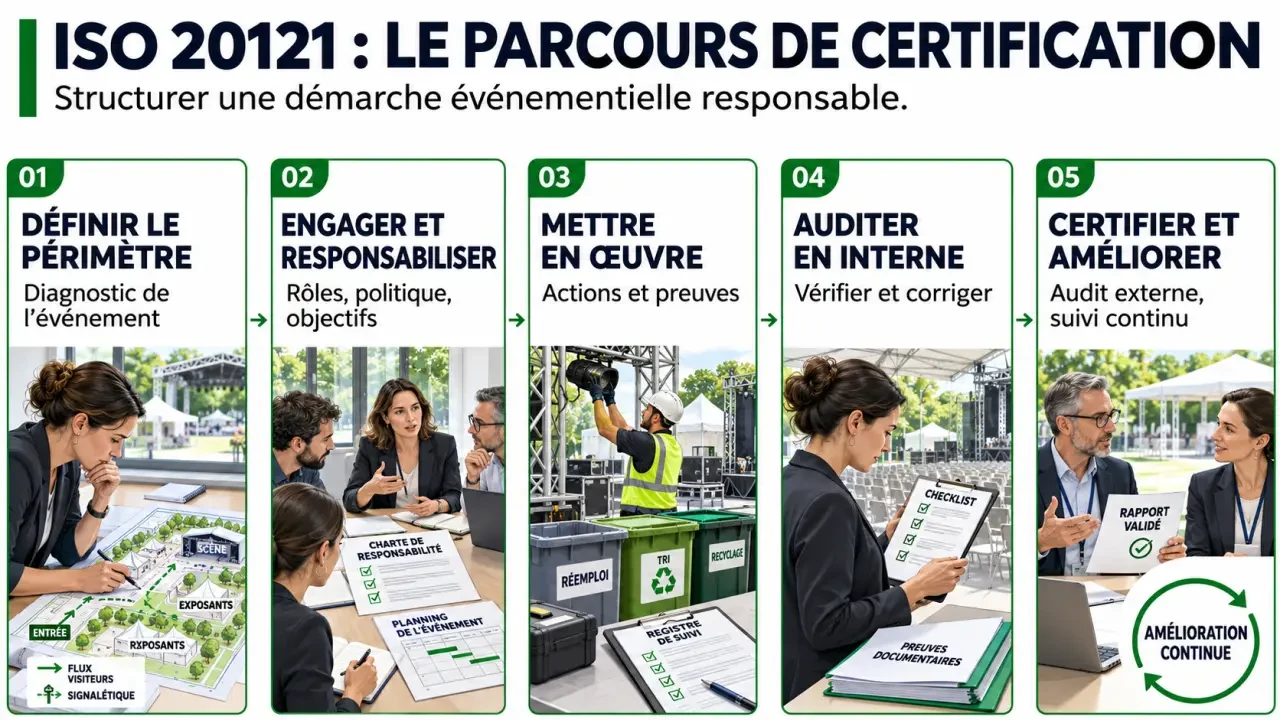
The 5 steps to prepare and obtain certification
1. Define perimeter and perform diagnosis
Delineate the activities involved, then compare your practices to the requirements of the standard. Identify stakeholders: teams, clients, suppliers, participants, residents and public partners. The diagnosis must highlight the significant issues and gaps to be addressed, not just the good initiatives already undertaken.
2. Setting commitments, objectives and responsibilities
Management formalizes a policy, designates those responsible and assigns resources. Then translate priorities into objectives. For example, improving accessibility requires assessing barriers, planning actions, designating a person responsible and collecting returns from those concerned. A general intention is not enough.
3. Implement the system and retain evidence
Integrate criteria into vendor consultations, operational procedures, and team exchanges. Maintain the elements that demonstrate their application: buying decisions, reporting, training, reporting and incident handling. The documents must reflect actual practices, rather than constitute a file parallel to the activity.
For a one-time event, prepare a « Transmission capsule » A short file of arbitrations, contact details, indicators and errors not to be repeated. When the team disperses after dismantling, this memory avoids starting from scratch. It transforms an ephemeral experience into reusable learning for the next edition.
4. Evaluate operations before external audit
Conduct an internal audit and management review to verify the effectiveness of the system. Are the objectives moving forward? Do the teams know their responsibilities? Do deviations lead to corrective actions? A blank audit can help to prepare, without replacing such evaluations or being systematically mandatory.
5. Conduct certification audit and process deviations
The certifying body shall review the documentation and then the implementation according to the agreed programme. It may identify non-conformities requiring corrections and additional evidence prior to the certification decision. After obtaining the certificate, plan follow-up audits and renewal according to contractual terms: continuous improvement does not stop at the certificate.
Inclusiveness and social heritage: translating developments into actions
The last revision, published in April 2024, reinforces, among other things, attention to inclusiveness and social heritage. For an already committed organization, the challenge is to compare its system with this edition and then adjust its practices and evidence. A simple change of reference in documents is not enough.
Inclusiveness exceeds physical access to the place. It also calls for consideration of the conditions for participation, the readability of information and the needs of different audiences. The answers must be built with the people concerned, rather than assumed in their place.
The social legacy raises another question: what remains after the event? These may include acquired skills, sustainable local cooperation or material reused by associations. Distinguish the actions performed, their observable results and the effects you cannot yet demonstrate. This caution makes the assessment more credible.
Budget, calendar and partners: framework the request for estimates
There are no universal costs or deadlines. The scope, number of sites, complexity of activities and maturity of the system influence the preparation and audit. The calendar should also be able to observe actual practices, taking into account the dates of events.
Separate the budget into separate items: internal time, standard acquisition, training, support, initial audit and follow-up. An audit fee alone does not therefore represent the total cost of the procedure.
- Describe your perimeter: activities, sites, teams and events concerned.
- Specify your maturity: existing procedures, indicators and audits already carried out.
- Ask for details of the offer: audit time, travel, monitoring, renewal and processing of variances.
- Check the conditions: reference edition, auditor skills and rules for the use of the certificate.
AFNOR Certification and Bureau Veritas offer this certification. Distinguish the consultant who prepares the organisation of the independent body that assesses it; ISO develops standards but does not issue certificates.
To start, consult the official ISO presentation and the text of the standard, and then the resources of the Ministry of Culture according to your sector. Trainings, guides and webinars, notably offered by Green Events, can facilitate appropriation. The first useful action remains to appoint a pilot, define the perimeter and organize a diagnostic before setting an audit date.
Updated on 17 November 2026