Published by:Élodie Maurel-Lescure— Editor specializing in various
Reread, corrected and validated by:Guillaume Martin— Editor in Chief
Updated on 27 September 2026
A clay house is not a curiosity reserved for eco-villages. It is a way of building, renovating or decorating with a natural material, often local, that is found in more sober housing projects. Depending on the project's ambition, clay can form walls, compose an inner coating, enter raw earth bricks or simply serve decorative objects in self-hardening clay. The essential point remains the same: clay gives good results when it iswell protected, well ventilatedand used in the right place.
Contents
What a clay house really means
In everyday language, expression covers several realities. It can be a building in raw ground, an old house restored with earth materials, a contemporary habitat incorporating clay coatings, or a decorative universe made of pottery, modelling and artisanal objects. This nuance counts because the requirements are not the same betweencarrier wallAnd a cup shaped by hand.
Clay, raw soil, torchi: do not confuse everything
The clay is a fine fraction of the earth. In construction, it plays the role ofnatural binder, often associated with sand, vegetable fibres, straw or aggregates. Raw soil is an uncooked material, implemented in various forms: torchi, pee, bauge, adobe or earth bricks. The torchi, for example, usually combines a wooden structure with a soil-fibre mixture applied in filling.
Inside a house, clay is also used for coatings or mineral paints. In this case, it does not wear the structure, but it alters the atmosphere of the rooms: matt appearance, mineral touch, soft colors, participation in the balance of ambient humidity. It is often the easiest entrance door to discover this material without engaging a heavy construction.
An ancient tradition restored to the taste of the day
Building with the earth is nothing new. Many vernacular architectures used the resources available on site, well before the industrialisation of materials. This return of clay is explained today by the search for less processed materials, the interest in craftsmanship and the need to improve interior comfort without multiplying synthetic products. The clay is therefore part of a logic of continuity, not a fashion effect.
The benefits of clay in habitat
The clay seduces because it addresses several current concerns: environmental impact, thermal comfort, perceived air quality, natural aesthetics and repairability. It is not magical, but it possesses qualities consistent with an approachbioclimaticsand sustainable home.
Occupational rules and reference texts on raw land| Access official documents and professional rules governing construction and coatings in raw soil.
A natural, local and little transformed material
When it is extracted and prepared near the site, the earth limits transport and industrial transformation. Unlike cooked or heavily manufactured materials, the raw soil retains a short cycle logic: it can be amended, reweighed, reworked or reused as appropriate. This sobriety is of particular interest to self-builders, old building renovators and eco-construction architects. It also responds to a simple expectation: use a legible material, without unnecessary complexity.
A real role in interior comfort
The clay is appreciated for its capacityhygroscopic: it can absorb and then restore part of the ambient humidity. In a properly ventilated room, a clay coating helps to limit the feeling of air too dry or too wet. It also bringsthermal inertiawhen used in bulk, e.g. in a raw earth wall or thick bulkhead, which helps smooth temperature variations.
You have to see a house as a set of rooms that work together. A wall on the ground, a well overflowing roof, a protected base, controlled ventilation and well oriented openings work together. If one of these elements works on a temporary basis, comfort deteriorates: moisture stagnates, flour coated, the wall becomes weakened. The clay recalls a logic often forgotten in fast projects: the performance comes from assembly, not only from the choice of a renowned ecological material.
Construction techniques and possible uses
Before choosing a technique, it is necessary to distinguish three levels of use: structure, envelope and finish. The more clay is involved in building stability, the more skills, studies and validations the project requires. For an interior finish or decorative object, the approach is more accessible.
The main methods under construction
The pee consists of compacting soil in a formwork to form massive walls. The bauge, close to the cob in the Anglo-Saxon vocabulary, uses a soil mixed with fibres, mounted by successive liftings. Raw earth bricks, sometimes called adobe, are moulded and dried before assembly. Torchis fills a frame, often made of wood, with a mixture of soil and fibres.
Each technique depends heavily on the composition of the earth, the local climate, the type of foundation and the protection against the beating rains. Too much clay can crack when drying; too sandy land may lack cohesion. This is why mixing tests, samples and accompaniment by a skilled craftsman or office are essential for a living project. On this type of site, precision counts as much as ecological intent.
More accessible coatings, paints and renovations
For renovation or interior decoration, clay coatings are often simpler to consider. They apply to compatible supports, after preparation, and create a breathable surface with a very warm look. They are particularly suitable for old houses, natural partitions, earth walls, but also for some modern supports when a suitable hanger layer is provided.
Clay paints offer a lighter option. They bring a matte, mineral finish, less thick than a coating. In a room, living room or office, they create a soft atmosphere, without looking for too smooth a decorative effect. The result depends heavily on the preparation of the support: an irregular, dusty or too closed wall will rarely give a lasting rendering.
| Use | Level of difficulty | To be checked before starting |
|---|---|---|
| Self-hardening clay object | Easy | Decorative use, slow drying, possible protection |
| Clay paint | Accessible | Healthy support, suitable primary, ventilated room |
| Inner coating with clay | Advanced special effects | Support compatibility, thickness, drying time |
| Raw earth wall | Advanced video editing | Technical study, water protection, local rules |
Limitations, precautions and errors to be avoided
Clay has a major weakness: it does not like stagnant water or repeated infiltration. This limit does not make it fragile by nature, but it imposes a rigorous design. Sustainable earth architectures are rarely those that ignore water. They are the ones who guide her away and let her evacuate.
Protection against moisture is a priority
A well designed base, a roof with sufficient overflows, maintained gutters and good runoff water management are essential. Inside, ventilation remains just as important. A clay coating can help regulate moisture, but it does not replace effective ventilation or compensate for a leak, capillary lift or wall enclosed behind an impermeable coating. Without this vigilance, matter quickly loses its assets.
Regulation and insurance: do not improvise
For new construction or heavy transformation, urban planning rules, stability requirements, guarantees, process insurability and local requirements must be checked. Some raw earth techniques are perfectly controlled by professionals, but they require a solid record. Self-construction may be possible at certain stages, provided that it does not confuse participatory construction with structural design. The good idea is always to anticipate before setting up the walls.
Another point of vigilance: self-hardening clay used in creative recreation is not a building material. It is used to make decorative objects, cups, incense racks, wall ornaments or miniatures. It shall not be used for structural parts or for food use unless the manufacturer has explicitly indicated it and the suitable finishing is required. This distinction avoids many errors of departure.
Concrete ideas for starting with clay at home
Not everyone has a land, an architect and a bioclimatic home project. On the other hand, it is possible to introduce clay gradually into its interior, to test the matter, understand its behavior and create a more artisanal aesthetic.
For decoration and DIY
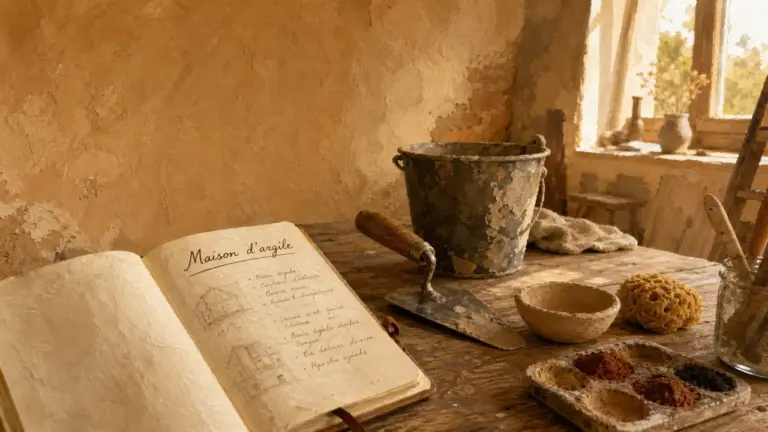
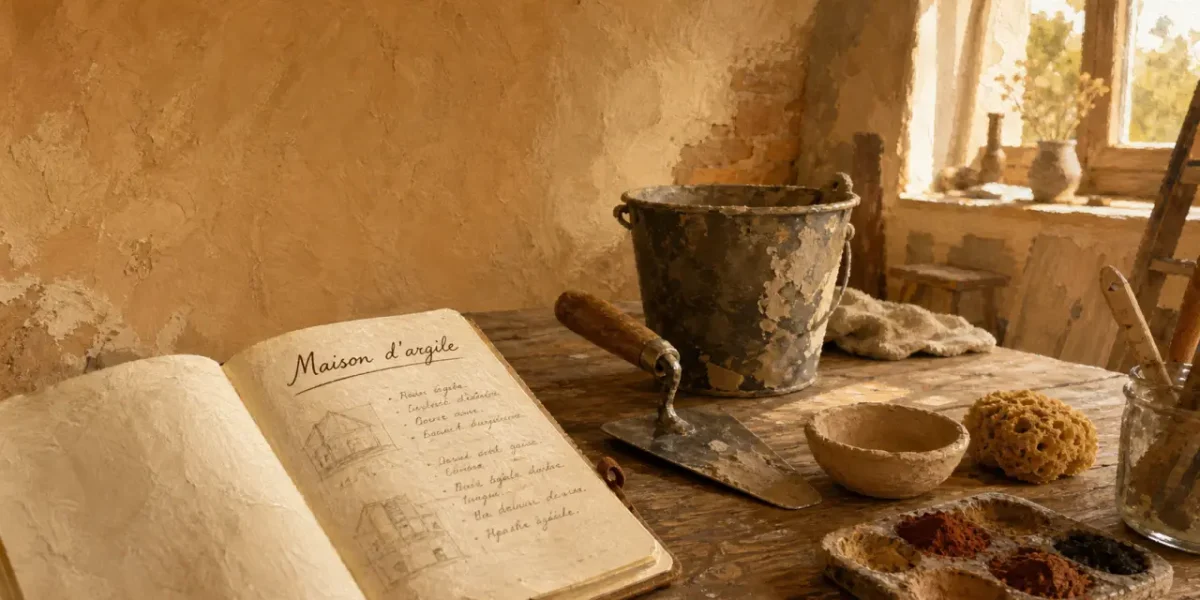
Self-hardening clay makes it possible to create simple objects without potter oven: jewelry cups, wall suspensions, small decorative vases, photo holder, brand-places, abstract reliefs or miniature houses. The right reflex consists of working not too thick shapes, letting dry slowly and gently sanding the edges once the piece is hard. Surface protection may be added according to use, but the object must remain decorative if the material is not intended for water or food.
To vary the tests without complicating life, it is better to go on simple forms and repeat the same idea several times. This helps to detect cracks, correct drying and obtain a coherent set. One can thus create a useful and decorative small series, without looking from the outset for too complex pieces.
- Choose a home pottery kit if you start and want the basic tools.
- Focus on simple shapes to avoid cracks when drying.
- Create a small coherent series: cup, candle holder, suspension and incense holder.
- Test pigments, engobes or paints on a drop before decorating the final piece.
For a more ambitious housing project
If the objective is to build, restore or coat an important surface, the best first step is to observe the existing: type of walls, traces of humidity, exposure to rain, ventilation, nature of supports. Next, it is useful to meet skilled craftsmen, visit construction sites or follow a practical workshop. Eco-habitat fairs, short formations and self-builder networks allow us to compare the seductive idea with the reality of the terrain.
To buy clay or objects, options vary according to the need: creative leisure shops for self-hardening, suppliers of environmentally friendly materials for coatings, potter craftsmen for unique pieces, creative platforms for inspiration and customization. For a clay house in a constructive sense, the purchase of material is only one step: the choice of technique, the design of details and the skill of implementation will make all the difference. This is where the project takes its real form.
Updated on 4 August 2026