
Published by: Élodie Maurel-Lescure — Editor specializing in music training
Updated on 23 March 2026
Far from any elitist idea, the chamber music offers everyone a unique listening, sharing and expression space. Each musician – passionate amateur or curious newcomer – can find his way there, progress at his pace, and discover all the richness of the artistic dialogue lived on a human scale. It is not uncommon to see real spontaneous exchanges within a set, where benevolence takes precedence over competition.
Contents
What is chamber music?

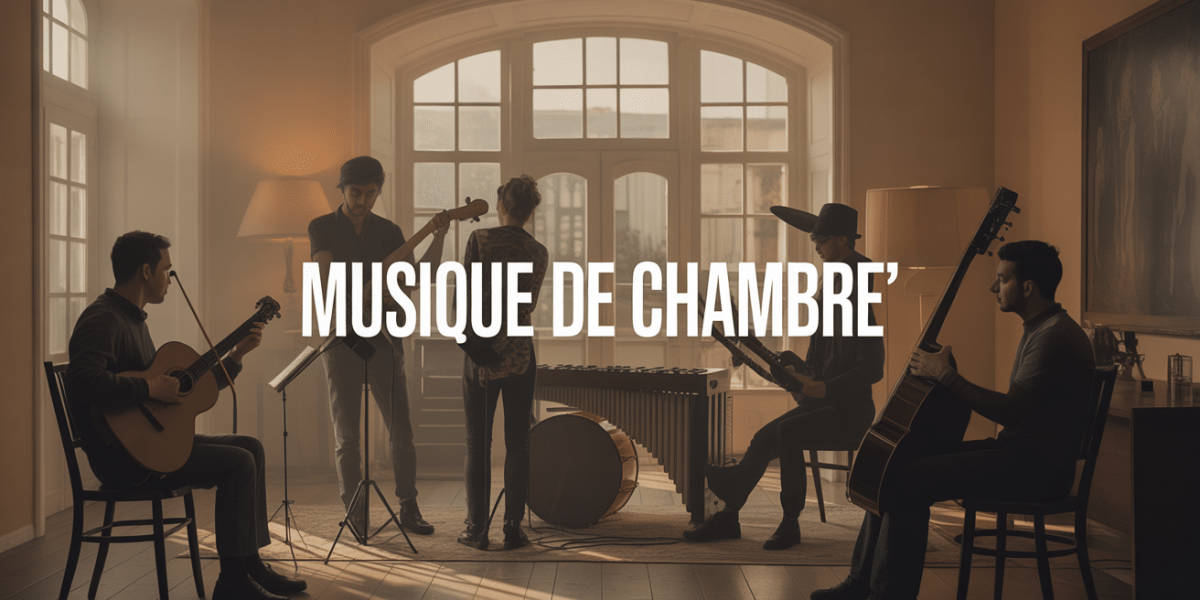
Choosing chamber music means opening up to an art while in intimacy and conversation – away from the effervescence of the great scenes, but from a real emotional intensity. It is freely defined as a music thought for a limited group of musicians, usually two to nine, gathered without conductor.
Originally established in the XVIe and XVIIe In Europe's private salons and palaces, chamber music has been distinguished by its warm climate and shared listening. Unlike orchestral music (regularly more than 40 musicians, up to 80 or 100), here, equality prevails: everyone plays a major role, without option of withdrawal and without leader. It is also noted that acoustics plays a very special role – the room, often more intimate (which the very term of « Chamber » At the same time, there is a strong interest in an immediate proximity between musicians and the public. A music teacher said that these first concerts in quartet, in small halls, remain engraved much longer in memory.
And, reassuring detail, this world is not reserved for insiders! Many French conservatories welcome amateur ensembles and festivals such as Between Winds and Marais – of which 7e edition 20 musicians in July 2025 – multiply opportunities to discover, listen, or even try adventure. The question « Is that for me? » often comes back: in most cases, the answer is positive, regardless of level or experience. Some participants attest to having started without any group practice, to return conquered by the collective spirit.
Small glossary to get started
It is not necessary to use all the specialized vocabulary to enjoy chamber music or begin practice. Some concrete benchmarks:
- Polyphony: intermixing several independent musical lines or voices
- Instrumental voice: specific part of each instrument within the set
- Educational Directory: selection of works thought for progressive learning
- Instrumental training: type of group formed by number and family of instruments
- Writing in quartet: traditional arrangement consisting of four instruments, often with strings
Sometimes, a simple technical word can intimidate – yet, one learns frequently by listening or trying (a little bit to bits sometimes... and it adds to the attraction!). A head of the desk recently confided that his most beautiful memories of the workshop come from these spontaneous trials.
Major formations and their flagship works

When we dive into chamber music, the diversity of the groups shapes astonish: from the classical duo to the octuor, each configuration brings its color, its balance, and its reference works. Many find a new impetus to rediscover their favourite instrument or experience a more confidential sound environment – sometimes just a session to change its perspective.
How to find yourself in the jungle of ensembles?
Between duos, trios, quartets and others, we regularly wonder what exactly these names correspond to. Good to know – the higher the number of musicians, the wider the sound palette, but mutual listening becomes more subtle. Some concrete benchmarks:
| Format | Common instruments | Reference work |
|---|---|---|
| Duo | Piano and violin, cello and piano, flute and guitar, etc. | Piano violin sonata by Franck |
| Trio | Piano, violin, cello (trio with piano) or three winds, among others | Trio op.100 by Schubert |
| Quartet | Often 2 violins, viola, cello (string quartet) | Haydn Quartets, Beethoven (opus 59), Shostakovich (15 in total) |
| Quintet | Addition of alto, double bass, piano or wind | Mozart Quintet with clarinet K581 |
| Sextuor and more | Varied mixes (cords, winds, piano) | Beethoven's Sextuor op.81b |
Between duo and sextuor, there are no two identical assemblies: each instrument is offered a tailor-made place, with constantly renewed nuances. We like to emphasize that Chostakovitch composed 15 string quartets – a palette sufficient to accompany a lifetime of exploration. Some music lovers even note that these successive discoveries renew each listening season, sometimes with family.
Masterpieces not to be missed (small subjective selection but proven)
When the directory abounds, it may seem difficult to make a choice. For those who want to orient themselves, a few essential works often catch attention:
- Divertimento KV136 Mozart: liveliness and elegance, often programmed in festival
- Quatuor op.44 Mendelssohn: communicative energy, virtuosity and sharing
- Trio « Archiduc » Beethoven: breadth and accessibility combined
- Wind quintet Opus 56 by Danzi: daring instrumental colours
- Bartók Quartets : six scores that revolutionize the genre in XXe century
Some teachers recommend attending a concert or listening to excerpts for real « feel » The spirit of chamber music. A novice listener tells us that his first experience in the room was a real click to explore new horizons later. Is that really surprising? In practice, testing what's happening near home or simply on a platform is often enough to open the door. A Sunday morning concert... and the tour is played!
Why learn or discover chamber music?
Adventure in chamber music, whether it is a listener or a musician, goes well beyond the technique. We enter a space of exchange where each voice counts, creating a living ensemble that invites experimentation. For many practitioners, it is a true school of collective listening and creativity – and an excellent antidote to isolation (especially among teenagers, according to some educational workers).
The contributions for the musician... and for the public
Following groups of adults and adolescents in search of collective practice, it is quick to grasp how small-scale play breaks down barriers. Without a leader, everyone learns to listen to each other, to adjust their own score – and it is not uncommon to see crazy laughter born through shared mistakes. It is a natural way to progress, discover new styles or simply renew your practice.
A trainer asserts that collective education, integrated early in the conservatory cycles, promotes confidence-building and develops musical autonomy. As for the spectators, there are many who witness a particular feeling of intimacy – being « near » musicians, share emotion, discover gestures, sometimes exchange a few words at the exit... This striking proximity often makes you want to come back, proof that the barrier between stage and room tends to decrease.
Human and emotional issues
Where the orchestra gathers everyone under the direction of a conductor, chamber music builds a real « small group »: the responsibility is balanced, and every repetition becomes a human adventure, full of unexpected emotions. The majority of the major festivals devote a significant part of their programming to chamber music, precisely for this human dimension, which is difficult to find elsewhere.
For music lovers wishing to explore a collective practice, a choir in Paris: how to choose and join the right vocal group can be an ideal gateway to enriching musical experiences.
Through chamber music, one can also explore the work of all known composer of the 21st century, a true reflection of contemporary developments in this art.
To encourage and structure amateur music practice, the Confédération musicale de France: the pillar of the amateur musical network plays an essential role in promoting chamber music throughout the territory.
For anyone who has already attended the first rehearsal of a trio or quartet, the experience rarely leaves indifferent... It's a little bit like incruding into an ultra-privileged friendly conversation, and sometimes listeners suddenly find themselves passionate about group dynamics, without waiting for it.
Where and how to learn, listen or practice?
It's not necessarily obvious to know by which end to take things. However, resources and opportunities are flourishing, often more accessible than one can imagine.
Conservatories, festivals, online resources: the toolbox of the curious
Whether you're already an amateur practitioner or a student parent, there are options for everyone:
- The TPM Conservatory and regional RRCs regularly offer internships, workshops, group courses and theme meetings.
- Some festivals like Between Winds and Marais (7e edition from July 11 to 18, 2025) reserve an important part to chamber music and welcome About 20 musicians This year.
- On the resource side, the Philharmonie de Paris brings together guides, playlists, videos and downloadable documents, all freely (think about consulting their new products from time to time).
We sometimes forget that amateur practice is not a matter of excellence: today, everywhere in France, there are open ensembles, very user-friendly summer courses, and pedagogues who gladly accompany the most reserved musicians. Some teachers even share this feeling: after a first session, barriers fall, and audacity develops quite naturally.
How to choose a concert or work?
The simplest route is usually to consult the local calendar or the programming of a festival in your area. The iconic ensembles (string quartet, trio with piano, wind quintet...) are regularly featured, and the institutions' sites offer selections adapted to a wide audience. For example, each season ofBetween Winds and Marais includes concerts « family » 1 hour 6 or 7 years, which makes discovery accessible to all.
A musicologist recently noted that sometimes the most difficult thing is to cross the threshold: launch without apprehension, listen, dialogue, let yourself be trained – you will see, chamber music works a bit like a refined dish that you don't get tired of... We come back, we explore, we surprise ourselves to share. And why not, it could become an unexpected (belle) passion!
FAQ and resources to go further
Available: PDF guides to download, glossary, thematic playlists and local contact modules. For any need for information or resource suggestions, you can Write directly to us or visit artists active in your area. Nice exploration to you... and the pleasure of one day exchanging around chamber music!
Updated on 23 March 2026