
Published by: Élodie Maurel-Lescure — Editor specializing in music training
Updated on 23 March 2026
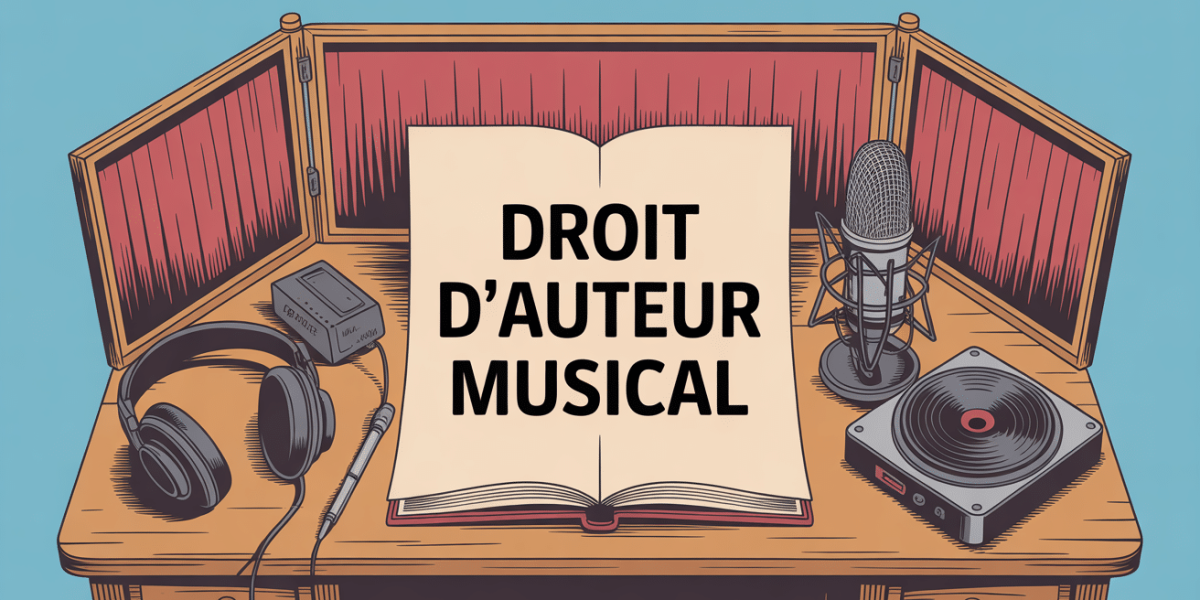
Mastering the musical copyright is not reserved for an elite: it is above all a concrete way to preserve the value of your musical creation, avoid legal traps and remain autonomous in your artistic universe. This guide brings together the key points to know: principles of protection, tips to prove priority, choice of approaches according to your needs... So many elements for your creativity to advance without being restrained by uncertainty or administrative heaviness.
Seizing the basics of copyright in music does not require any legal expertise. Composer, beatmaker, producer or even amateur artist: it is best to appropriate certain fundamentals to limit plagiarism, litigation or abuse of works. Good surprise moreover: protection is set up, creation; The few reflexes that will make it a real shield, without falling into the usual traps, have yet to be developed.
From the moment an original musical work is materialized on a medium (partition, recording, digital file...), the author enjoys exclusive rights without particular formality: this results from automatic acquisition. These rights, which are distinguished in « morals » and « heritage », supervise the broadcasting, commercial exploitation and paternity of music. In France, the legal period extends « the author's life and for 70 years after his death ». Sometimes a simple personalized consultation with a professional (average of 120 € TTC with a 48h response time) suffices to unblock a situation – but seeing a lawyer is not always indispensable!
Summary of key points
- ✅ The protection of musical copyright is active from creation without formality.
- ✅ Rights are divided into moral (intangible) and (transferable) property rights.
- ✅ A simple use of a professional can avoid many legal complications.
Contents
Music Copyright: The Essentials to Protect Music

Here are some benchmarks to clarify your steps, desecrate the procedure, and anticipate what you really need to know before you publish, collaborate or sign a contract.
What is copyright in music?
Compose a song or invent a melody already places you under the legal protection of copyright – without necessarily realizing it. However, what creations are concerned, and where is the starting point for this protection?
Musical work: a simple and concrete definition
The Intellectual Property Code (articles L112-1 to L112-2) covers all musical creations, whether they are compositions (melody, harmony, rhythm), songs with lyrics, or instrumental works. The protection applies as soon as the work has a touch of originality, characterized by the imprint of the author. In fact, a simple inventive jingle or an unprecedented arrangement is as valuable as a symphony.
- The work must have been fixed to a medium (recording, handwritten partition, digital file, etc.)
- Protection takes place directly without any administrative action
Specifically, recording music on a software or capturing a song on your smartphone is enough to activate copyright. For a creator accustomed to other universes, this reflex differs significantly from the formal deposit obligation... Some people are surprised to discover this point regularly during MAO or beatmaking training: this changes the relationship with creation!
Who's protected? Composers, authors, interpreters: the perimeter
As a matter of priority, the law protects the creator of composer music, parolier, arranger since his contribution is original. Performers (songwriters, musicians, etc.) are mainly related to neighbouring rights (we will return to this below), while producers (labels, studios, publishers) have rights relating to recordings. In this music sector, collaboration is the norm; setting upstream roles and responsibilities sometimes avoids much conflict of ego or sharing.
Moral and Heritage Rights: What Differences?
In France, the distinction between moral rights considered untouchable and property rights, which are passed on or negotiated, remains paramount.
Moral law: a personal and indivisible link
Moral law protects the author's artistic personality, with several attributes:
- Be recognized as the true author (right of paternity)
- Impose or refuse any modification of the work (respect for integrity)
- Deciding when or under what conditions (right of disclosure)
- Request, subject to conditions, the withdrawal of the work from the public (right of withdrawal or repentance)
This right accompanies the author until 70 years after his death; His heirs then exercise the prerogative. It cannot be definitively surrendered, even contractually! A trainer evoked the case of an shocked composer to discover his title transformed into a television ad... Some see it as a matter of principle, but the impact is relatively concrete.
Heritage rights: exploiting and valuing its work
Heritage rights give the power to control the distribution of his works and to perceive their fruits. We distinguish the right of reproduction (copies, editions, streaming...) and the right of representation (concerts, radio...). These rights can be transferred or transferred (publishing, exploitation contracts, etc.) and regularly generate the bulk of the income.amount paid by SACEM, fees). To be remembered: even in case of assignment, the duration remains capped (life of the author + 70 years). Special cases exist (e.g.: extension for World War II, which is rarely more than 6 additional years according to the texts of October 2023), but these situations do not concern the majority of current composers.
How to protect his music and prove his anteriority?
No need to panic: if the protection is automatic, prove the anteriority in case of a dispute requires some simple precautions. The famous question of « deposit » comes back during each workshop: sacem, INPI, alternatives, what is really true?
Recognized methods to prove creation
The deposit is never imposed, but in the event of a dispute concerning the paternity of a piece, it is better to be able to present evidence dated prior to. There are several options:
- Envelope Soleau INPI : official registration dated, valid 5 years (renewable), current cost 2023: between 15 € and 30 € for an online procedure.
- Deposit with bailiff or notary : strong evidence guarantee, rate adjusted for service; generally 60 to 150 € for a deposit.
- SACEM Declaration Protection by the return, coupled with rights management and revenue collection.
Note: The trick of sending your own music by recommended is now exceeded. Instead, any dated, technical element, tracing the creative process (working session, computer file, recording) can still prove in support, at least in the first exchanges. Often, a simple project export is used as an argument in case of disputed anteriority.
Good to know
I recommend that you keep all the dated elements of your creative process, such as session source files or records, as they can be evidence of priority in case of litigation.
Collective or individual management: how to choose?
Collective management, mainly SACEM, remains the preferred route for most songwriters: collection and redistribution of fees are centralized (e.g. 75 % Copy France revenue for entitled persons, 25 % for creation or dissemination). Managing individual rights remains possible, especially if one opts for dissemination « free of rights » (Creative Commons, for example), but beware of complexity or oblivion when several intermediaries intervene! A professional recently pointed out that an oblivion to report could be expensive, even for a simple soundtrack on the Internet.
Exceptions and limitations to exclusivity
Music copyright protects creation seriously, but the law also provides for situations where copying or adaptation remains permitted (private copying, parody, teaching, etc.). These exceptions are strictly marked: it is better to have them in mind not to restrict too much or overestimate the scope of protection.
Legal uses: what the law permits
Some benchmarks may shed light on what is, or is not, lawful use:
- Private copy : authorised for individual use, not for collective, commercial or public dissemination.
- Parody, pastiche, caricature : admitted when the transformation respects the spirit of the original work and does not affect it (some professionals consider that the border remains difficult to assess).
- Educational exception : allowed in the context of teaching, but never for public use outside the educational setting.
- Quote : very framed in music: tolerated only for short fragments and when justified, never for a main melody (many more flexible in literature!).
Some find out at their expense that a short music sequence still requires permission – as a young creator learned from a YouTube video. Isn't that sometimes counter-intuitive?
Contracts and commercial exploitation of music
In the musical field as elsewhere, nothing replaces a written agreement: any partnership, commitment to exploitation or professional use deserves a clear trace, whether it be publishing, ordering or audiovisual production.
To avoid disputes, find out how musical plagiarism: understanding, detecting and protecting your creations can help you secure your works.
To complete your knowledge, find out how to opt for a music without copyright: a guide to legal, practical and creative solutions.
To effectively protect your musical creations and avoid litigation, discover this concrete guide to protect your works and copyright.
Key contracts: publishing, ordering and production
Each collaboration or commercial exploitation requires one or more contracts, specifying: the identity of the works and stakeholders, the sharing of rights and revenues, the duration of exploitation, the geographical scope, the obligations of each individual or the remuneration arrangements.
- Musical publishing contract : transfer to a publisher of the management and promotion of the work.
- Phonographic production contract : framework the production and distribution of the recording.
- Order contract : formalizes the creation of specific music for remuneration.
Let us add that accepting a contract assigning all its rights, without guaranteed minimum, exposes to lasting disillusionment (the testimony of a spoliated instrumentalist circulates regularly among professionals). It is worth investing a few tens or hundreds of euros in a check before signing, rather than seeing the fruit of his work disappear.
FAQ copyright music: your practical questions
Here is an overview of recurring cross-examinations during coaching, training, or in specialized guides:
How can I protect my music?
Create a proof of priority (Soleau envelope, SACEM inscription, deposit at bailiff) from conception. This approach is often recommended even if the law already protects you ex officio.
What is the duration of protection?
On French territory and in most international conventions, your property rights cover your entire life and extend 70 years after you disappeared. Some works have an extended duration if they have been affected by world wars.
What evidence is recognized in the event of a dispute?
The Soleau envelope and the deposit via SACEM are commonly accepted by the courts. Deposits at notary or bailiff add an official addition. It should be noted that postal self-deposit is no longer considered.
What are the main exceptions to musical copyright?
Private copying, parody, pedagogical use and very brief quotation are retained (in practice, the criteria of appreciation are quite strict; Some musicians prefer to systematically inform themselves before reusing an extract).
How to declare his works to SACEM?
All you have to do is create an account, save each work – including the co-authors if necessary – and transmit partitions or files. A few identity and completeness checks are necessary: the online route is rather accessible, even if the help of a professional remains useful in complex files.
Need a model contract or personalized advice?
Many models and resources exist in open access to specialized sites or recognized organizations (such as SACEM). For atypical or sensitive situations, call an expert: it is generally observed that the current trend is to consult quickly, billed around 120 € with response within 48 hours. Why deprive yourself of it if it secures your approach?
Resources, useful links and navigation
- SACEM : Society of Authors, Composers and Music Publishers
- INPI : National Institute of Industrial Property (Soleau envelope)
- Guide Légis Music – Copyright and Music Licences
- Copyright file – Philharmonie de Paris
Keep in mind: protection begins with good reflexes and daily vigilance. Last point to note – dare ask for advice, keep systematically track of your creations, and continue to place the pleasure of composing before any procedure; This, let's say, is the best guarantee to feed your musical journey!
Updated on 23 March 2026