
Published by: Élodie Maurel-Lescure — Editor specializing in manual arts training
Making a cardboard furniture requires more than cutting and sticking: you have to design a stable structure, choose the right material and master the finishes. To choose a training course, start with the desired result: make a first bedside, create your own models or prepare a cardboardist activity. The programme, the time of practice and the support must correspond to this objective.
Contents
Choose a route suitable for the furniture you want to create
A discovery workshop and vocational training do not meet the same need. The first allows to try gestures on a guided project. The second must teach you to make technical decisions, correct your mistakes and work progressively in autonomy. Parting with a successful piece of furniture does not yet mean knowing how to design another.
| Your goal | Format to be preferred | Point to be checked |
|---|---|---|
| Discover the material | Creative workshop or initiation | Real participation in cutting and assembly |
| Making Home | Practical placement with complete project | Plans, methods and tips for replicating actions |
| Developing your own models | Development modules | Design, structure selection and fault resolution |
| Preparing a professional activity | Detailed course, possibly certifying | Evaluation, autonomy and economic preparation of the project |
Present or distance: focus on correcting gestures
In the face, the trainer can observe the pressure exerted during cutting, a lack of squeezing or a poorly positioned bonding. At a distance, ask if the offer includes individualized photos or video conferencing, rather than videos alone. Also check the required workspace, the tools to buy and the shipping terms of the supplies.
Workshops can accommodate beginner adults, children in a suitable setting or animation professionals. Accessibility remains to be confirmed with each organization: standing stations, gripping tools, cutting and timing of sessions may require adjustments.
Identify a program that teaches structure, not just decoration
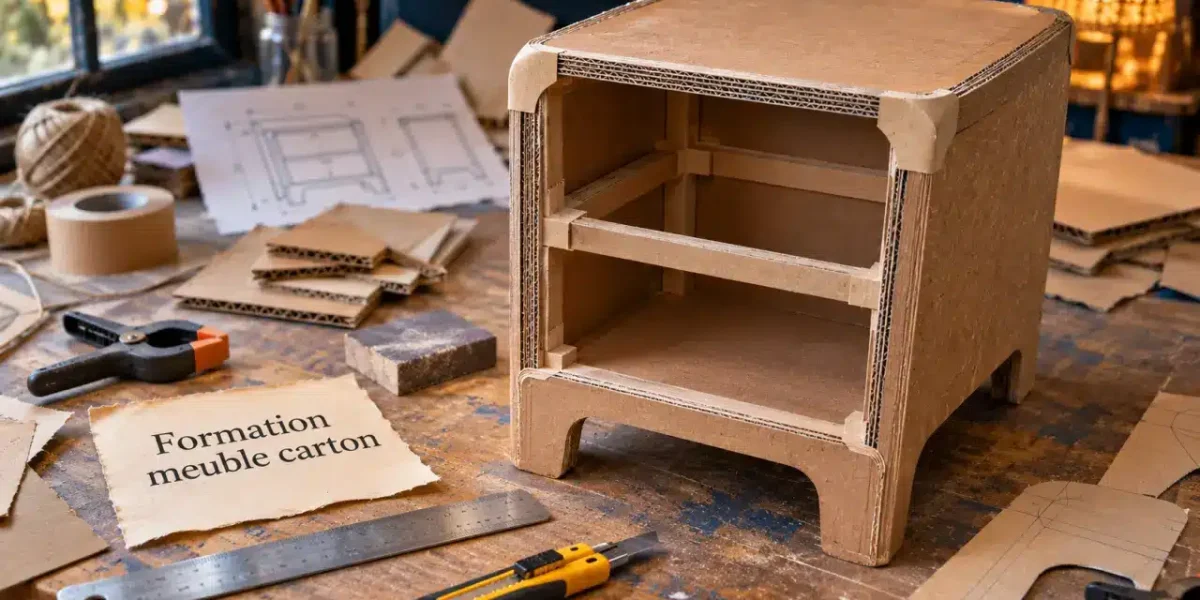
A solid formation follows the whole manufacture: draw a sided plane, select a clean and dry board, identify the direction of the grooves, cut, assemble, strengthen and protect the surfaces. The trainer must explain why a technique is suitable for a form or use, without presenting the carton as an indestructible material.
Official certification sheet: creation of recycled cardboard furniture | See France Competencies of RS5120 certification, replaced by RS7098 certification.
Crossings, glued and crossed feet: understanding differences
Cross-section construction is based on an interior frame that links the profiles of the furniture. The glue consists of assembling several thicknesses to obtain the desired properties. Cross feet use cross elements to form a support. Depending on the route, sculpture and mâché paper can complement these methods to work on volumes and decorations.
To understand the strength, imagine a current that crosses the furniture: the weight must find a continuous path from the tray to the ground. An opening, a broken cross-section, or a poorly positioned support can break this path. Ask the trainer to draw this course of effort on your plan: you will learn to place reinforcements where they are useful, rather than multiply layers everywhere.
Finishes and eco-design: anticipating the life of furniture
The program must also address songs, sanding, coatings and protection against daily use. Reusing cardboard is of interest, but glues and finishes influence the repairability and recyclability of the object. An eco-design approach includes reducing cutting losses, avoiding unnecessary mixing and planning repairs. For a loaded seat or cabinet, stability tests and use limits are essential.
Compare organizations on concrete evidence
Several actors propose different approaches. Cartonable puts forward 16 years of experience. The School of the Carton presents courses of 30 to 720 hours, up to and including 24 weeks. Cartonelle indicates a personal journey including 1 400 hours of training. These benchmarks inform the experience or extent of the offer, but do not replace the examination of the chosen program.
Schmulb offers intensive courses and training; Gerfiplus deals in particular with manufacturing techniques and the establishment of a workshop. To divide offers, ask for the number of participants, the prerequisites, the time spent on practice and the possibility to work on a personal project.
Read the achievements and testimonies with method
Prefer examples of furniture made by students, not just the trainer's catalogue. A useful feedback specifies the initial level, the module followed, the difficulties encountered and what the person managed to do on his/her own. Photos of the intermediate stages can also reveal the work of structure, invisible under a careful finish.
Finally, ask what happens after the internship: correction of a plan, response to assembly difficulty, access to supports or additional session. This accompaniment can make the difference when you start your second piece of furniture without an imposed model.
Check budget, certification and funding
There is no relevant average cost without distinguishing between leisure workshop, accompanied internship and professional career. Cartonelle displays a marker of 12.5 € per hour, with a degressive rate depending on the duration: confirm the amount applicable to your session. Always compare quotes to equal scope, integrating supplies, tools, travel, accommodation and possible evaluation costs.
Qualiopi, CPF and certification do not designate the same thing
Qualiopi concerns the quality of the body's processes; she does not constitute a diploma of cardmaker. An end-of-training certificate also does not amount to a registered certification. The École du Carton mentions the references RS5120 and then RS7098: check on France Competencies the current card, its validity, the skills assessed and the authorized bodies.
The eligibility for the CPF must be checked for the specific action envisaged on the official service. Depending on your situation, care can also be studied with an OPCO, France Travail or a regional scheme. No financing is automatic: get the agreement before making an irreversible financial commitment.
Before registration, request a document indicating the dates, times, equipment included, cancellation conditions and the expected evaluation. If you leave with your creation, also anticipate its congestion and transport.
Preparing for the suite: autonomous leisure or cardboard business
For personal use, a realistic objective is to reproduce the method on a simple piece of furniture and then adapt its dimensions. For conversion, manual skills are not enough: it is also necessary to estimate manufacturing time, quantify consumables, organise the workshop and verify the existence of a customer.
Tracks can include custom creation, decorative elements or workshop animation, provided you master safety and pedagogy. Training, even certifying, does not guarantee orders or income. Before a long journey, making a first play and meeting potential customers allows you to confront creative envy with the constraints of the profession.
The right choice is the path that makes you progressively autonomous. Ask for a detailed program and estimate, then compare the actions taught, the planned corrections and the expected results. A well-targeted internship is worth more than a promise of expertise without verifiable objectives.
Updated on 24 November 2026