
Published by: Guillaume Martin — Editor in Chief
Creating stories that mark online is no longer reserved for content experts. If you want to project your creative ideas, you might as well know how to use the basics of traditional storytelling and format them for digital environments. This guide will show you how to adapt traditional methods to all the tools that digital offers, to produce engaging and interactive stories, from the first essay to the final rendering.
Contents
The historical evolution of digital storytelling
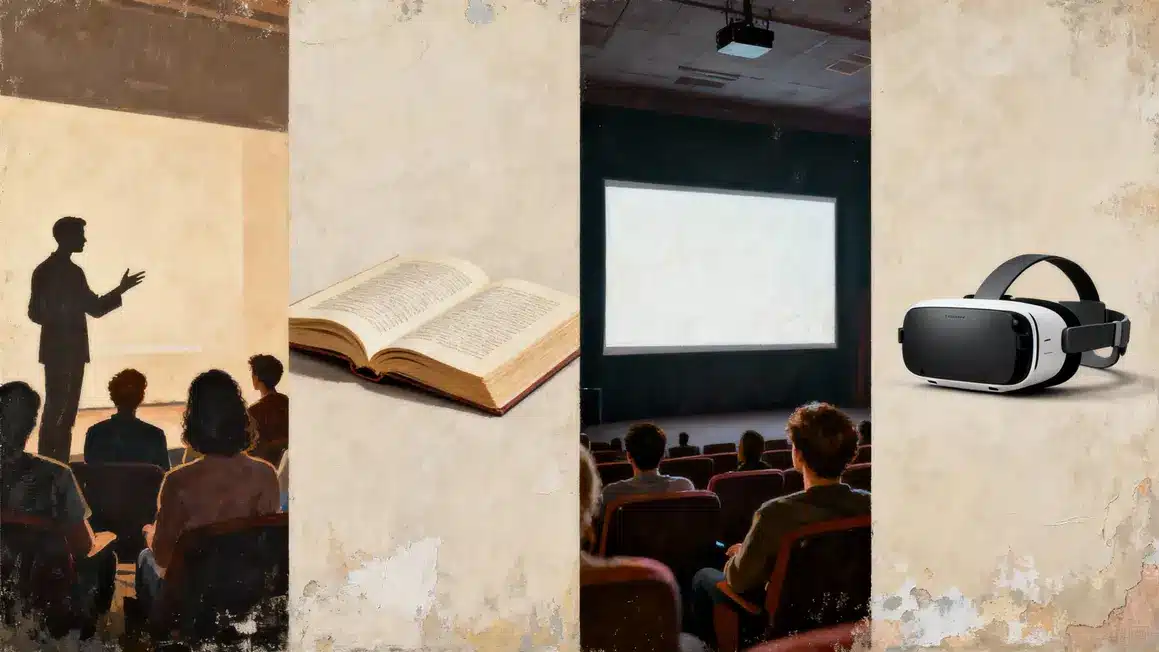
Storytelling has always existed, from oral accounts to frescoes written and then filmed. Today, telling a story goes through video, interaction and immersion through multiple media. If the oral narration involved the listener in the moment, the writing then the book offered a structure and wide dissemination. The arrival of cinema and video games introduced participation and direct emotion: the audience is not simpler spectator, but actor in the unfolding of the story.
Digital now allows everyone to experiment. Through platforms such as Genially or iMovie, a person can compose visual and interactive stories, whether for learning or communication. Brand and pedagogy appropriate these tools: Lego turns advertising into a sharing experience, educational applications make teaching live via interactive maps or animated lessons.
The increased and virtual realities go even further: a work or exhibition becomes accessible via total immersion. The user can explore a decor, click on objects, listen to stories told by each element of the museum or product. The new digital narratives give life to orality, but on a large scale and with multiple interactivity.
The fundamentals of digital storytelling according to Joe Lambert
Joe Lambert identifies seven pillars to integrate to structure a successful digital narrative:
- Emotional Content: gives rise to a precise emotion adapted to the public. For example, a video about a reunited family quickly causes empathy if music, context and rhythm are chosen.
- Perspective: chosen which tells, determines the angle to frame the story. A 360° video format can plunge the viewer into the protagonist's head.
- Narrative structure: lays a thread (introduction, conflict, resolution) to keep the public engaged.
- Authenticity: take advantage of real experience and documented anecdotes. For example, making-ofs or behind the scenes of a project, often more effective than the clean hand narrative.
- Soundtrack: skilfully uses audio transitions and atmospheres to enhance consistency.
| Key elements | Practical application |
|---|---|
| Emotional content | Increasing sound pressure in an interactive video. |
| Perspective | Narration guided by the user experience. |
| Narrative structure | Cut in action for a net conductive wire. |
| Authenticity | Anchoring in reality through an anecdote or testimony. |
| Soundtrack | Immersive sound atmosphere adapted to each sequence. |
Think from the beginning about the desired feeling and the points of action to be left to the spectator. These principles will help to achieve a coherent narrative and make the most of digital tools.
Key tools and platforms for digital storytelling
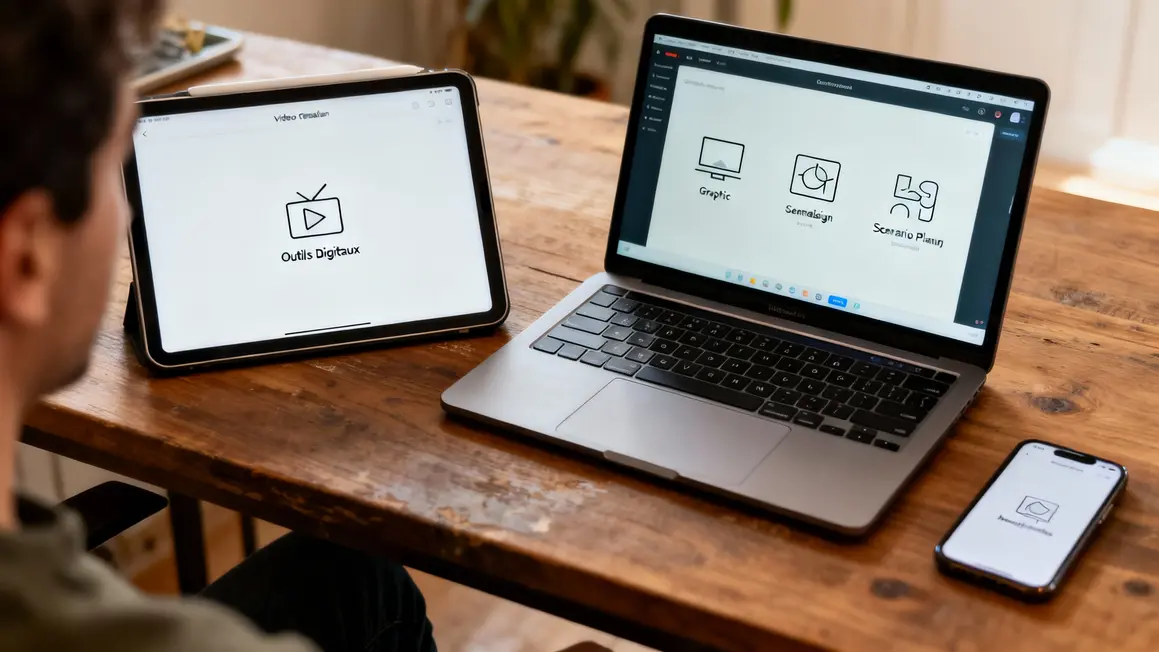
The production of digital stories greatly benefits from access to various tools, each with its strengths:
- Genially: Designed for interactive stories and educational presentations.
- iMovie: intuitive video editing for beginners on Mac.
- Canva: express visuals for illustrations or social networks.
- Amazon Storyteller: Writing and structuring scenarios for text narration.
- Adobe Spark: creation of cross-media content (video, graphics, web).
- Increased/virtual reality: for immersive experiences (exhibitions, product demos).
- Tools of AI: Advanced customization and adaptation of the narrative to each user.
| Tools/Technologies | Main use | Main asset |
|---|---|---|
| Genially | Interactions, digital pedagogy | Quick grip, attractive design |
| iMovie | Audio-visual assembly | Simplicity, effective templates |
| Canva | Graphics for social networks | Mass Library, Quick Results |
| Amazon Storyteller | Screenplay, narrative frame | Structured organization of the narrative |
| Adobe Spark | Media combination and visual narrative | Flexibility, various formats |
| AR/VR | User Immersion | Tenfold sensory experience |
| IA | Personalization of stories | Real-time response, optimized engagement |
The main thing is to associate the tool with the objective of your project, without looking at technical complexity from the outset. Start with what makes your story easier, adjust as you need it.
The essential role of emotions and interactivity
Digital formats change the place of the audience: emotion and interactivity are now at the centre of the story. A story that resonates allows the viewer to influence the direction or even bring his personal touch. For example, Lego delivers campaigns where each participant shapes the story according to his or her choices, transforming a simple advertisement into a shared adventure.
Amazon Storyteller places the reader at the centre: he chooses the plugs, becomes an actor and sculpts the narrative path. The direct involvement of the viewer creates a strong commitment and promotes the appropriation of the narrative.
Interactivity is not a decorative option, but a condition for engagement. Proposes choices, variants or an open purpose to be completed by the user. When public decisions influence history, investment and memory are strengthened.
Practical applications and benefits of digital storytelling
The impact of digital storytelling is true both in marketing and education: Apple turns its users into narrators through the campaign « Shot on iPhone »encouraging to publish and share their photos valued as stories. In class, Genially and interactive tools increase interest and accelerate understanding, with a measured progression of +24% (source: EdTech Magazine).
The benefits are concrete: high conversion rates when history puts the client at the heart of the project, increasing student engagement with content gamification. These methods adapt to everyone thanks to the variety of accessible tools: Canva to illustrate a video tutorial, YouTube to broadcast a creative project, TikTok for short format.
What distinguishes digital storytelling is its amplifying effect: emotion, active participation and ease of access encourage memory and loyalty. This is relevant for a brand like an online training or an individual portfolio.
Current and future trends in digital storytelling
New technologies are changing the way stories are written. Artificial Intelligence already adapts stories to each profile in real time; platforms like Netflix or Spotify use these engines to customize each user's experience. Augmented and virtual reality enriches the participatory dimension: IKEA presents virtual products to the customer, making the discovery of the narrative and practical catalogue.
In the medium term, mixed reality will merge the digital and physical worlds: the narrative will be shaped live according to the emotions detected. However, the risk remains of losing authenticity in favour of the only technical feat; an overcrowded story of effects can be unsuited if it forgets the simplicity and sincerity of intent.
The future of digital storytelling will depend on the balance between innovation and narrative clarity. Creators will have to keep their message under control while exploring the possibilities offered by each new technology.
How to start with digital storytelling
The best starting point is to define the purpose of your project: emotion to transmit, method to apply. Structure your story: introduction, progress, resolution. Prioritise accessible tools (Genially, Canva, iMovie) before investing further in immersive or technical formats. Give priority to user experience: every public decision must be simple and intuitive.
- Identify the central message or emotion.
- Structure your story in three steps.
- Add an interactive touch, even simple.
- Test with relatives and adjust according to their return.
- Advance by testing, correct step by step.
Digital storytelling is learned through practice and regular testing. You don't need to master everything to dare start: progress at your own pace.
Digital storytelling FAQ
What difference between traditional storytelling and digital?
Digital multiplies possibilities: multimedia formats, interactivity, audience choice. Construction is no longer linear, the public becomes an actor.
What free tools to use in 2026?
Genially and Twine for interactive narratives, Canva for visuals, Audacity for audio, ZapWorks or EyeJack for free AR. Start with these solutions to start concretely.
How to measure interactivity in his story?
Better place a few clear action points than overloading options: proposes alternatives that modify the story, guides the viewer to find easily useful interaction.
How long to master digital storytelling?
Basics are quickly taken over (a few hours), but advanced mastery requires practice and repetition over several weeks. Take the time to iterate, efficiency will come with successive returns and corrections.
Will digital really replace conventional methods?
Digital storytelling complements traditional approaches. Some stories lend themselves better to linearity, others to modularity and interaction. Make your choice according to your purpose.
You want to get to the next level by creating interactive stories? Share your feedback or questions in the comments: your experience can inspire other creators of the guyomcorp.com community!
Moreover, if content has brought a new perspective, don't hesitate to share it on your networks. This helps other enthusiasts progress in the mastery of digital storytelling.
What are your main blocks or successes in creating digital stories? Tell us more and propose your topics to explore for future articles.
(Additional sources: EdTech Magazine, Netflix Tech Blog, specialized digital storytelling media)
Article written by Guillaume Martin, specialist in creative pedagogy and digital storytelling. Updated: June 2024.
Updated on 17 January 2026