
Published by: Élodie Maurel-Lescure — Editor specializing in music training
Updated on 23 March 2026
Dare to cross the door Pau-Béarn-Pyrénées, it is to offer his artistic project a framework where each journey takes on all its meaning, regardless of age, level or experience: here, the artistic training Step by step, through careful pedagogy, tailor-made accompaniment and open methods that encourage children as adults to express themselves fully, without fear of looking. After all, each passion deserves to flourish in a concrete, accessible and rewarding adventure.
Contents
The Conservatoire Pau-Béarn-Pyrénées, centre of regional artistic excellence

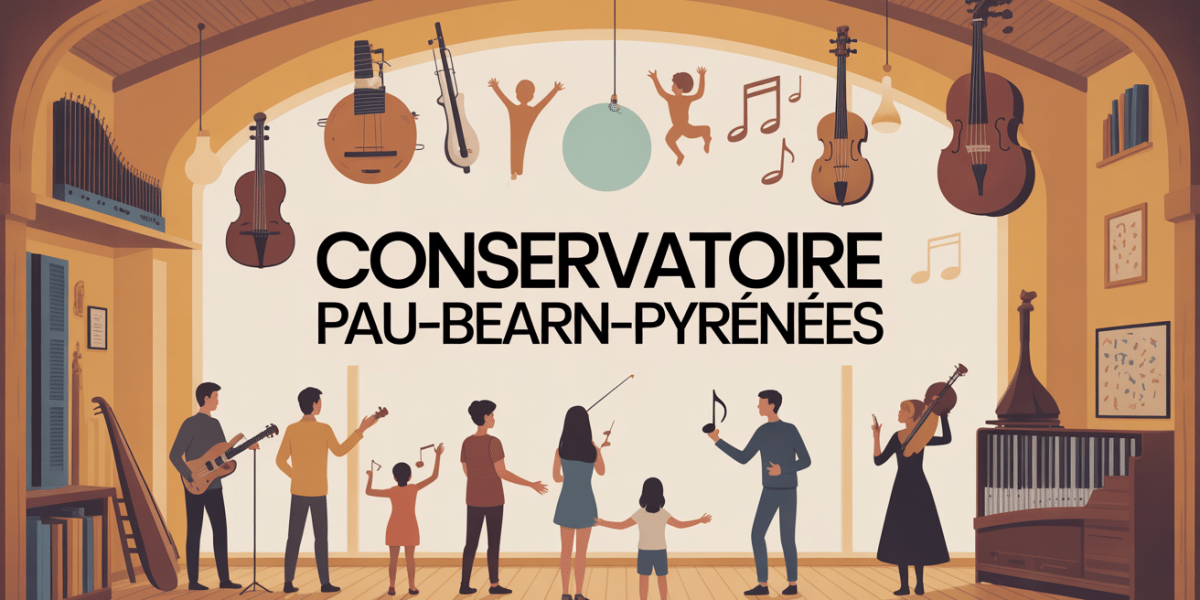
For many passionate families and adults, the Pau-Béarn-Pyrénées Conservatory now represents the decisive meeting point where one can grow and assert its artistic potential, regardless of the journey or experience. Since becoming a renowned conservatory with regional reach in April 2024, he has strengthened his reference place for artistic training in the Pyrénées-Atlantiques.
Public institution led by the Ministry of Culture, it brings together more 1,400 students, supported by 67 specialist teachers, in an environment that is both structuring and inspiring. This opening is immediately noticed: each student, from the youngest to the senior, has access to an adjusted course, whether they begin or perfect their practice. Here, a fixed point of routine: the conservatory plays a leading role in the cultural dynamics of Béarn, offering more than 40 rich and diverse disciplines.
Located in exceptional premises, marked by a living heritage (restored Cavaillé-Coll organs, contemporary auditorium, welcoming media library...), the conservatory is also distinguished by its commitment to inclusion and its real accessibility (transport Idelis, adapted devices). Its mission is clear: to ensure that as many people as possible have access to artistic excellence, while providing a solid foundation for those who aspire to career paths.
Summary of key points
- ✅ Artistic training adapted to all ages, levels and profiles
- ✅ More than 1,400 students supervised by 67 specialists, with more than 40 disciplines
- ✅ Strong commitment to inclusion and accessibility
Training offer: music, dance, theatre

From the 5-year-old who discovers music or dance to the adult who wants to refine his practice, the courses and experiences offered are of rare richness in Pau-Béarn-Pyrénées. It is in this diversity that the singularity of the place lies, as the local entertainment professionals regularly say.
Music: from awakening to graduate courses
All musical worlds find their place: classical music, contemporary creation, traditions, jazz, vocal or instrumental. Each practitioner can find himself there, whom he wants to taste of the piano, explore the voice, discover percussion or vibrate with the winds.
To be noted:
- ✅ One musical awakening from 5 years leading to specialized courses according to instrument or voice
- ✅ Highly valued collective practices: orchestras, ensembles, choirs throughout the curriculum
- ✅ Scheduled classes in partnership with schools in the sector
- ✅ Preparation for recognized degrees: CEM, DEM, and even DEC for the most invested
One teacher recently said that an adult had taken over the violin here after thirty years of pause, naturally finding his place among other passionate – like which, the door really remains open to all profiles.
Dance and theatre: complete curriculum for all ages
Dancing or acting? These are two paths that the conservatory makes accessible via complete cycles: dance (classical, jazz, contemporary, traditional dances) and theatre, from the level beginning to the doors of pre-professionalization. Discovery or fine technique combine in workshops, stage situations and real meetings with invited artists (a dancer recently evoked the richness of these informal exchanges).
The majority of students integrate their curriculum without excessive barriers: it is common to meet a completely novice child or a passionate retiree sharing the same scene. And to take the step smoothly, there are free listener formulas (around 30 € for some workshops).
Good to know
I recommend that you take advantage of the free listener formulas which allow to integrate some workshops from around 30 €, a good option to start without strong commitment.
Educational innovations and accessibility
Here, we avoid layering the old educational patterns: the conservatory Pau-Béarn-Pyrénées is illustrated by the creativity of its pedagogical approaches, its willingness to include each person, and the particularly personalized accompaniment of all the courses.
Semi-collective methods and project pedagogy
From the beginning, a key place is given to collective practice and cooperation: many courses take place in semi-collective, which encourages active listening, group dynamics, but also the pleasure of progressing at several rhythms. Some parents note that this organization limits dropouts, especially in the first instrument year.
Highlights:
- ✅ Alternative balanced between individual courses, workshops and regular public projects
- ✅ Cross practices encouraged: musicians, dancers and actors share multidisciplinary projects
- ✅ Specific support for students with special needs or with disabilities: dedicated referents, premises actually accessible
Is it possible to follow a particular handicap or constraint? Many user feedback confirms that listening and adaptation are an integral part of the current operation.
Diplomas and opportunities
In addition to the pleasure, those wishing to do so also have access to nationally recognized qualifications and diplomas, opening up to higher education or artistic professionalisation. Some former students testify that formal recognition values their commitment, even if they do not all pursue the artistic path.
Certifications: an official recognition
At each key stage, a diploma marks the progression: Certificate of Musical Studies (CEM) or Choreographic/Theatrical Studies (CEC/T), Diploma of Musical Studies (DEM), Diploma of Choreographic Studies (DEC) or Theatrical Studies (DET) of the references given by the Ministry of Culture. It is possible to choose the "leisure" path or to target a springboard towards a professional course, whether in music, dance or theatre.
| Diploma awarded | Main opportunities |
|---|---|
| CEM / CEC / CET | Deepening leisure or amateur |
| DEM / DEC / DEC / DEC | Competition, integration of a higher institution, access to artistic education |
Towards higher education or working life
Strong links exist with the University of Pau and several cultural actors in the territory: theatre companies, musical ensembles, live entertainment operators. Concerts, end-of-year shows and collective projects facilitate the integration or continuation of artistic studies, while highlighting the journey accomplished locally. Over the seasons, almost 9 former students join major regional or national schools, inspiring tangible pride at each coming-back concert.
Good to know
I advise you to take advantage of the many public events (concerts, shows) offered each season that value the work accomplished and facilitate the meeting with the professional community.
Infrastructure, access, school life
In everyday life, the quality of the journey is very important to the environment. The conservatory Pau-Béarn-Pyrénées has been investing for almost a hundred years in functional and stimulating premises: 70 rooms, auditorium, media library, not to mention the Cavaillé-Coll organ which is part of the treasures of the local heritage.
Accessibility, location and practical organization
Set up on Rue des Réparatrices in Pau, the conservatory is accessible via the public transports of the Idelis network, offers a well-kept handicap reception (lifts, adapted rooms), and offers a great range of hours from Monday to Saturday: it becomes possible to combine school, professional and artistic life. Some parents testify to the usefulness of the media library to take a break between two activities! (I myself saw Sacha, my son, reviewing the solfege several times during the intercourses. )
One point to be highlighted:
- ✅ 70 classrooms and studios, auditorium of 200 places
- ✅ Convenient media library, patio, cafeteria and changing rooms perfectly adapted
- ✅ Events open to the public: concerts, shows, regular exhibitions
To organize your year, you can find a detailed school calendar and an online "school life" area. This is also why anticipation becomes much simpler for families who juggle with several activities.
Contact, registration and rates
For any question, nothing easier than to contact the conservatory by email or telephone: the team is often greeted for its welcome and availability, after the return of many parents. The accessible rates are adjusted for priority audiences, with adapted formulas (free auditors from 30 €, family rates...).
Just like that.Argenteuil Conservatoire: an artistic pole open to all passions, the conservatory Pau-Béarn-Pyrénées imposes itself as a place of development for artists of all walks of life.
Like the Regional Conservatory of Boulogne-Billancourt: understanding everythingThe conservatory Pau-Béarn-Pyrénées is a must place for an artistic training of excellence.
Like the Cité de la Musique Marseille: cultural outreach and musical journey for allThe conservatory Pau-Béarn-Pyrénées is positioned as a key player in promoting artistic education accessible to all.
Address: 15 rue des Reparatrices, 64000 Pau
Tel: 05 59 98 45 88
Mail and detailed information : "contact" section of the official website pau.fr
It is better to consult the registration schedule (open from May to July for the September school year) and prepare the necessary documents in advance: proof of identity, domicile, letter of motivation if necessary (especially for certain specialized courses).
FAQ: answers to key practical questions
Because every family or student needs sometimes unexpected details, this is what you need to know about the most often, without detours.
From what age can one enrol in the conservatory?
Artistic awakening begins as soon as 5 yearsmusic or dance. Some disciplines can accommodate younger children, on a case-by-case basis, in collective initiation (a contact is then advised).
What are the rates and registration procedures?
The fees vary depending on the family quotient and the choice of route. It is generally found that the rates remain among the most affordable in the region for a public establishment: the free hearing formula starts at 30 € per year for certain modules or workshops.
What levels are being met?
All profiles, from complete beginner to confirmed student, or adult rehearsing or perfecting his practice, find their place. A trainer points out that the accompaniment adapts to each person's project and constraints.
What are the diplomas and opportunities?
The courses lead from the Certificate of Musical Studies (CEM/CEC/CET) to the Diploma of Musical Studies (DEM), Choreographics (DEC) or Theatrical Studies (DET), all recognized nationally and truly capable of gaining access to higher artistic studies or professionalization.
Are there any adult or scheduled courses?
Yes in both cases: adults benefit from adapted courses or semi-collective modules, while students and high school students can join, according to their records, scheduled classes in conjunction with national education.
Does the conservatory accommodate persons with disabilities?
Yes, thanks to a personalized reception: PMR access, dedicated devices, disability references and educational adaptation are integrated on request, in a daily inclusion policy. One educator recently reported that a tailor-made device had enabled the active participation of a visually impaired student.
Are there shows, concerts or events open to the public?
Of course: throughout the season, many shows, concerts and masterclasses are open to all, whether at the auditorium or in other partner rooms in Pau.
How to learn or register in practice?
All up-to-date information can be found on pau.fr, conservatory section. In just a few clicks, it is possible to ask a question, schedule a visit to the premises, or download the registration files (to be returned between May and July depending on the specialty).
Official practical resources
- School life of the Pau-Béarn-Pyrénées Conservatory
- Onisep – Conservatoire Pau-Béarn-Pyrénées
- Wikipedia – Pau-Béarn-Pyrénées Conservatory
Last update: June 2024 – Data likely to change.
Updated on 23 March 2026