
Published by: Élodie Maurel-Lescure — Editor specializing in music training
Updated on 23 March 2026
Daremusical awakening With your child, it is to offer him a joyful discovery of the sound universe, without preconditions or obligation to result: the idea is simply to play, explore his curiosity and accompany his growth smoothly. As each family operates in its own way and may have doubts, this approach values adapted activities, possible from the first months, where imagination and confidence spontaneously invite (and even the shy ones sometimes surprise themselves to flourish). It is regularly observed that the musical experience at home or in a workshop creates valuable links. Here is what we can remember to facilitate the family musical adventure, in all simplicity.
Summary of key points
- ✅ Musical awakening invites discovery without obligation of result.
- ✅ The activities are suitable from the first months of the child.
- ✅ The musical experience promotes family ties and trust.
Contents
Definition and objectives of musical awakening

Learning music from a young age? It's the heart of musical awakening! Unlike formal instrument learning, there is no need for solfege or performance objective here. The child is invited to explore the sound world, experiment and play freely – it is often where the most authentic curiosity arises.
In practice, many fun activities are offered: listening, singing, playing with rhythms or manipulating musical objects to stimulate hearing, coordination, attention and imagination of the little one. No objective of « produce a good musician », but rather to sow the foundations of sensitivity, self-confidence and the taste of discovery. Moreover, it is advisable to establish a joyful climate, without waiting for "good result", to encourage personal expression.
A trainer shared a workshop that limited the group to Maximum 6 registered (sometimes only 3) promotes individual and sincere listening. This intimate atmosphere, with short sessions between 25 and 40 minutes depending on age gives each child the opportunity to invest with pleasure.
At what age did the musical awakening begin? At everyone's pace
Some think that musical awakening begins from 3 or 4 years old... in reality, many workshops open their doors to babies as soon as 1 to 3 monthsespecially in suitable structures. Why propose so early? It is often found that the toddler's brain, even in its first few months, reacts intensely to the sounds, rhythms and human voice (an educator said that babies "absorb" musical atmospheres without filters).
A closer look: most musical initiatives target an audience of 3 months to 6 years, in mini-groups, with content that evolves as the development progresses. From 3 to 18 months, sensory discovery takes precedence: noises, voice games, simple objects ; then from 18 months to 3 years, the child takes an active part (dance, manipulation of instruments). Around 4-5 years, rhythmic experimentation and singing take more space.
Wonder if there is an ideal age to start with? We notice that spontaneous curiosity remains the safest guide, nothing prevents each family from finding its own tempo. This is also why it is better to listen to your child and respect the right time.
Main methods and supports – a palette for all styles
Perhaps you have heard of Montessori pedagogy, Dalcroze approach, or Orff method? These are all currents that today nourish musical awakening, each bringing its particular color. All these approaches emphasize active discovery, free play and physical investment rather than pure theory – some professionals emphasize the importance of shared pleasure.
Overview of recognized pedagogical approaches
It is worth noting that none of these methods are reserved exclusively for specialists: with a little training, they become accessible to all. Last point to note: each approach offers different benchmarks to accompany the child smoothly.
- Montessori: Place to autonomy with sensory material, concrete manipulations and respect for personal rhythm.
- Dalcroze: The sounds are apprehended by movement, dance – the child assimilates rhythm without conscious effort.
- Orff: Small instruments, xylophones, percussions, or collectives promote group creativity and collective games.
- Kodály: Song, voice and memorization of melodies and rhymes become tools for valuing musical language.
In fact, the majority of workshops or activities at home articulate these different elements. The resources to download also offer a variety of programs according to age: some guides include 22 and 64 pages, allowing everyone to find their account (sometimes the most unexpected become favourites at home !).
Good to know
I recommend you discover several musical awakening methods to choose the one that best suits your child's rhythm and interest.
What benefits for my child? Focus on "magic" benefits
It is often found that musical awakening acts far beyond mere entertainment: several studies highlight its effects on memory, concentration, motor coordination. As a group, the child develops his/her ability to listen to the other, build confidence and understand sharing.
One host recently said that after a session, several children were eagerly waiting for the next meeting, eager to "invent songs with their friends". Little anecdote: Sacha, my son, suddenly began to invent her own words after two weeks of workshop – proof that musical creation is slowly slipping into habits.
A significant figure: for the Sola Method, more than 120 parents shared a very positive experience (average score) 4,8/5) after a few months of workshops. Word of mouth, in some cases, is worth all speeches.
Examples of games and activities to test: daily music
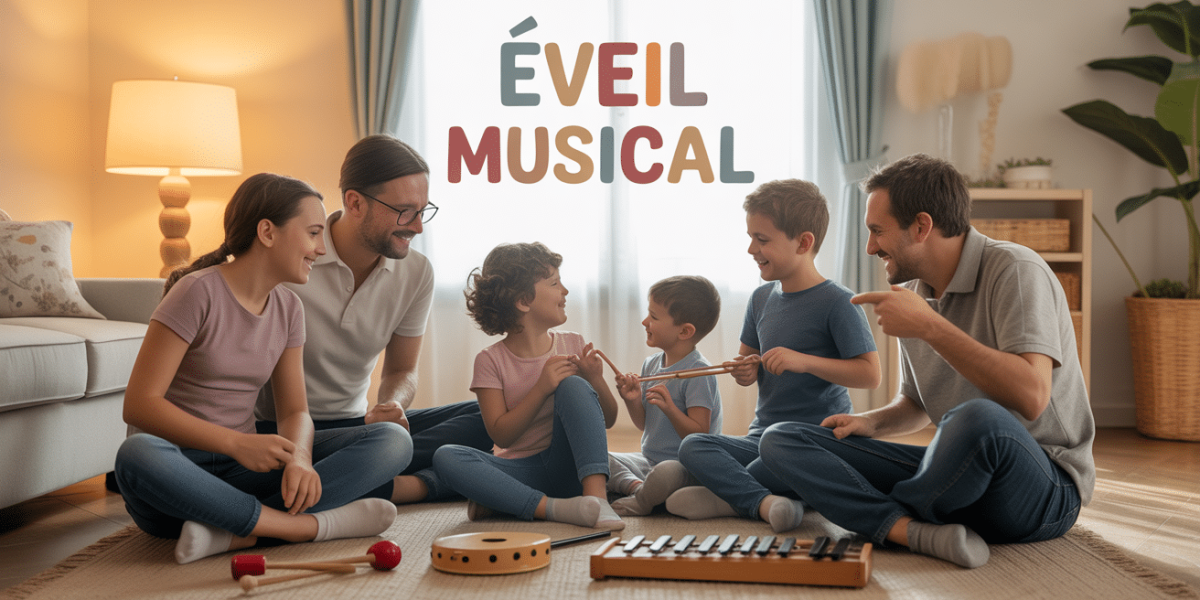
No need to equip with sophisticated equipment! Many musical activities are possible at home, in crèche or in a workshop. It is often recommended to vary the experiences: allowing to try, even without "musical ear", is just as enriching (a beginner dad surprised to mimic the violin with a spoon!).
Top 4 activities at home or in a workshop
- Show the sounds of everyday life: boxes, spoons, bottles of rice become true allies of sound exploration.
- Improvising a dance on quiet or rhythmic music, marking the tempo with hands and feet : some children appreciate « walking hard », others prefer to lie down and listen.
- Inventing a unique rhyme slipping the child's name: this game often triggers laughter, sometimes unexpected pride.
- Create a sound mat having various objects on the ground: textures, stamps, colours, all ready for curiosity and some will be amazed by the imagination that their child shows.
Usually, a home session lasts about 20 to 30 minutes...but it happens that we suddenly interrupt, especially if baby shows fatigue. This suggests that shared pleasure is essential regardless of duration.
How to choose your studio or practice musical awakening at home?
It's not always easy to make the right choice. Many parents want to encourage their children without being wrong or "forced". Fortunately, the musical awakening welcomes everyone – parents without musical knowledge included. Some workshops may limit the session to 3 children for the piano, valuing custom accompaniment and a soft atmosphere (a professional stressed the interest of listening to small groups).
To select a workshop, it is better to take into account the climate of the group, the facilitator's qualification (number are either trained or certified Montessori, Orff or Dalcroze), the flexibility and the price (between 10 and 30 € the group session; Sometimes PDF resources are available free of charge). If you prefer to try adventure at home, know that some sets – up to 9 activity booklets for 40 € cover an entire year (some parents use them week after week depending on the desire of the moment).
Last point to note: keeping an eye on how your child reacts remains a valuable criterion. Some love to push the song, others prefer to manipulate, listen to or invent everyday noises – all preferences have their value.
Frequently Asked Questions (FAQ: essential at a glance)
How old do you start?
As soon as possible, often as soon as possible 3-6 months depending on the family or specialized context, but nothing prevents you from starting later with the same wealth of experience.
How much does a musical awakening workshop cost?
In groups, there are average rates between 10 and 30 € for one session about 30 to 35 minutes, variables according to structure and city.
What difference with a classical course?
Musical awakening does not relate to the technique or the strict learning of an instrument. Sensory discovery, creativity and the sharing of simple pleasures are preferred.
To accompany your child in musical awakening, discover techniques and tricks to refine the musical ear in a playful and progressive way.
To complete your child's musical awakening, discover fall activities in kindergarten: creative ideas and resources for the season, perfect to stimulate his imagination and artistic sense.
For parents wishing to share their passion, find out how learning music at all ages: practical and motivational guide can enrich your approach to musical awakening in family.
Do I have to know how to play an instrument?
Not at all! Many parents experience music with their child for the first time. Workshops and guides are designed to be accessible to all without the need for prior knowledge.
How long does a session last?
Between 25 and 40 minutes by age and type of workshop. At home, it is usually advisable to focus on spontaneous enthusiasm: better 10 minutes playful than one hour imposed.
What materials are needed?
In the workshop, small instruments (maracas, bells, xylophones) are often offered. At home, a few ordinary objects are enough – some parents start with a box and a spoon alone!
Testimonials and feedback
The voices of families are often the most valuable source of inspiration. Here are some feedback from the workshops:
« My son had a hard time concentrating, but since we took part in the musical awakening workshop, he is looking forward to this moment! » Amélie, Paris
« We downloaded a 22-page activity guide, perfect to improvise home sessions without pressure! » Aurélien, beginner dad
In a specialized workshop, it was mentioned that out of a hundred opinions, the satisfaction rating exceeded 4,7/5... it is often observed that some parents no longer hesitate to recommend experience.
Download or go further: practical resources and useful links
Would you like to try? Several specialized sites (Philharmonie de Paris, Mon Eveil Musical, parental associations...) offer:
- Guides to download from 22 to 64 pages according to the themes, to vary the pleasures
- Complete packs of 9 booklets for 40 €, covering all seasons and desires
- Short videos to accompany parent-child games every day
- Calendars of workshops or initiations near you, according to your family's needs
To test without commitment, also consider the free trial offered by some workshops; or subscribe to a specialized newsletter, in order to regularly receive ideas for games and new rhymes to explore with family.
Finally, we often find that the essential thing is to enjoy and exchange. After all, the music is invited long before the notes on the score!
Updated on 23 March 2026