Published by: Guillaume Martin — Editor in Chief
Updated on 23 March 2026
Why a monumental work like « The empty chair » Has it become a necessary crossing point for anyone who questions the artistic commitment and memory of contemporary struggles? The installation of the sculpture at the Théâtre du Soleil, in 2020, was nothing unusual. This article proposes to give a structured look at the birth of this singular monument, its historical and political resonances, the scope of its staging, but also the concrete reactions of witnesses and users of places engaged such as the Cartoucherie de Vincennes. If you are looking to understand how far and how a work can become a tool of resistance, a landmark for memory or a milestone in a creative journey, you are in the right place.
Contents
Historical and political context around Liu Xiaobo

Liu Xiaobo was not just a dissident. He was incarnate. peaceful resistance to China's repressive machine, mixing stubborn courage with an assumed choice for dialogue rather than confrontation. It was the principle of « remain faithful to his convictions »even at the cost of his freedom.
His active involvement in the Tiananmen uprising in 1989 placed at the heart of the discussions: hunger strikes, calls for negotiation, the desire to avoid bloodshed. These actions did not prevent the tragedy of 4 June, but they determined the course of a life committed to change through speech, despite the censorship and brutality of an authoritarian state.
The drafting of the Charter 08 Another milestone was a clear call for democratic reforms and the rule of law, inspired by Czech models of resistance. Liu Xiaobo knew that his commitment could cost him a lot, and he was finally sentenced to eleven years in prison, several of them in isolation, who did not begin his non-hate posture, despite general incomprehension.
In 2010, the Nobel Peace Prize It is attributed to him. His absence – made visible in Oslo by an empty chair – deeply marks the minds: Liu Xiaobo is absent from the free world not by choice, but by the arbitrariness of a regime that attempts to erase dissent. He died in prison in 2017, leaving behind a legacy that weighs far beyond his death.
Meaning of the empty chair at the Nobel ceremony
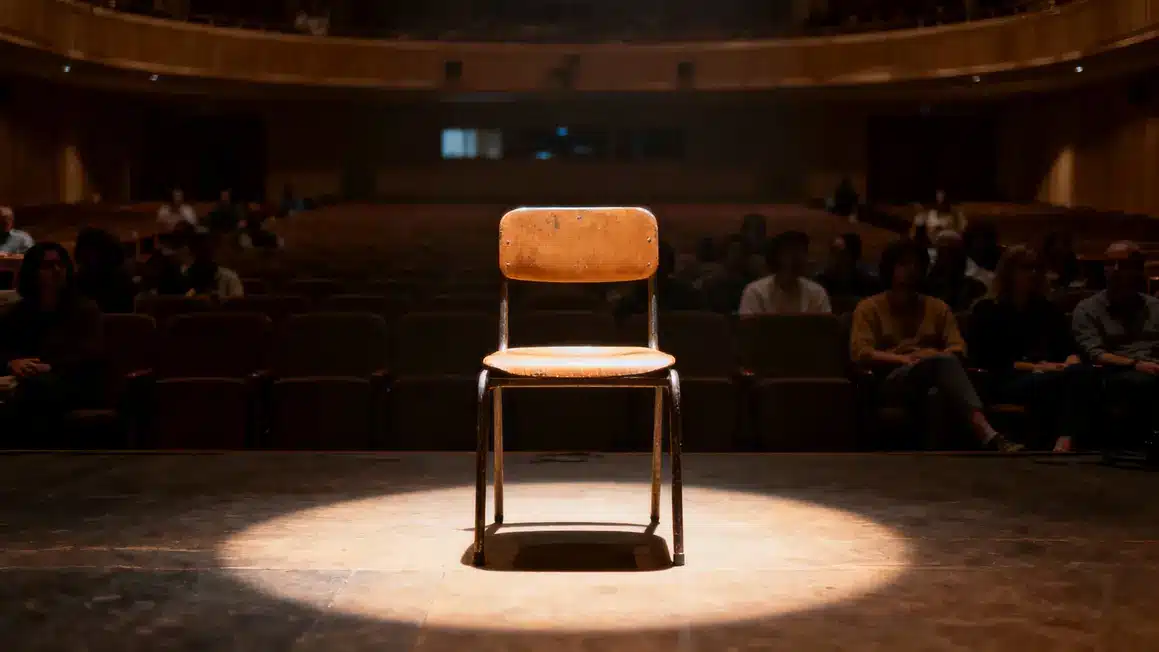
The empty chair at the Nobel ceremony is often cited (and taken over since) as a gesture of rare power. This physical absence becomes the symbol of all gagged voices, starting with those that are never shown. The object, by its emptiness at the centre of the stage, embodies more effectively than discourses the full extent of repression in China and elsewhere.
This scenographic choice highlights the universal experience of silence imposedNot only that suffered by Liu Xiaobo, but also that suffered by many human rights defenders around the world. The light of this absence provides a starting point for all memories, starting with those sometimes erased from public debates.
Since 2010, this image has been imposed in the debates on freedom of expression and art: to show the vacuum is to refuse to forget, and to make censorship impossible to ignore.
Wang Keping and sculpture tribute
Wang Keping, an exiled sculptor and co-founder of the collective of the Stars, has always been committed to artistic practices that shake the established order. His forced arrival in Paris in 1984 never diminished his desire to provoke by matter: his sculptures were against academicism and the docility imposed by the Beijing regime.
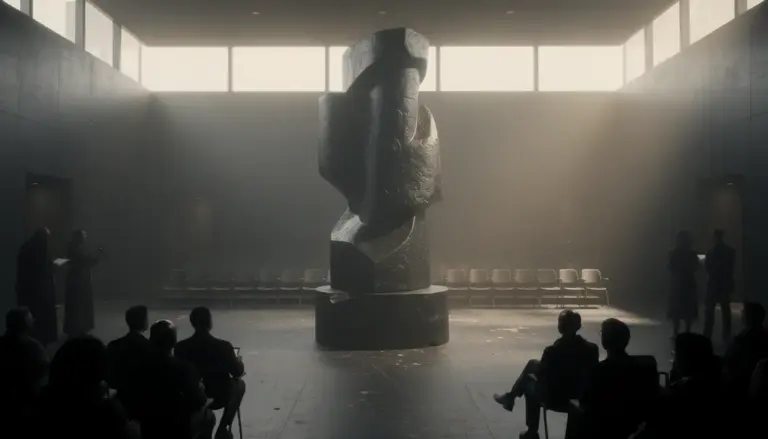
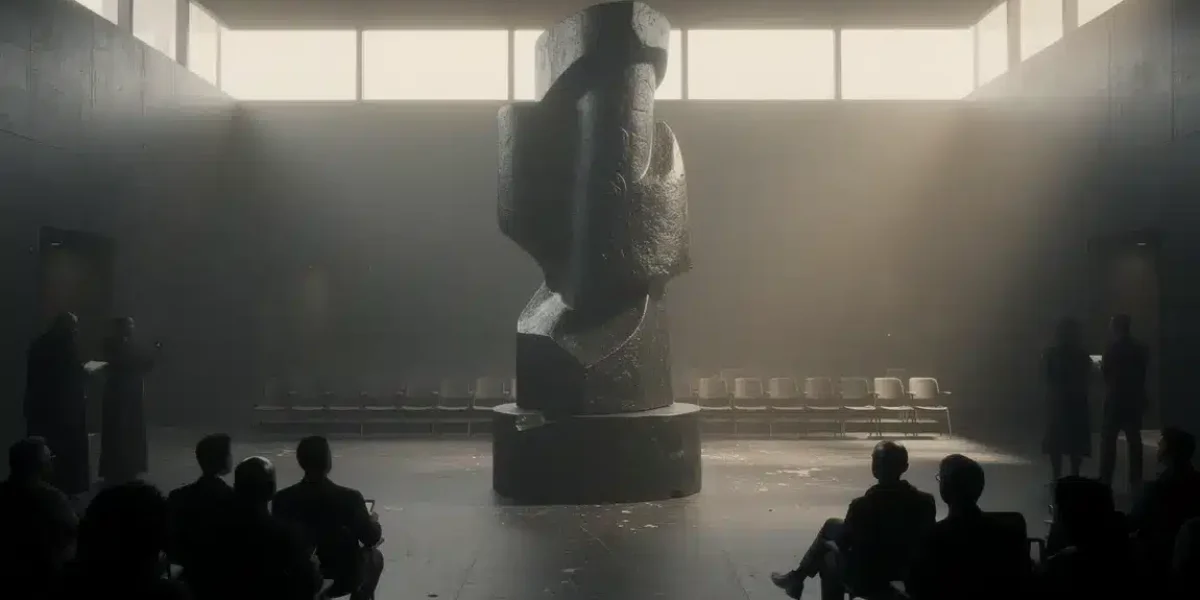
Sculpture « The empty chair », explicit tribute to Liu Xiaobo, measures three meters and immediately imposes the silence and weight of absence. The choice of cast iron, raw and solid, refers to the hardness of the enclosure and the unalterable nature of the memory. The presence of solid bars around the seat, a simple geometric structure, directly evokes the prison cell and the deprivation of liberty imposed on each dissenting voice.
Here Wang Keping goes beyond the monument: he proposes a concrete manifesto against systemic erasure of resistance figures. The work, silent but impossible to forget, recalls that the memory of the fight can anchor in the raw volume – far from the spectacular.
Itinerary of La Chaise Vide through its facilities
The history of « The empty chair » is also that of his travels and obstacles. First presented to the European Parliament in 2019, the sculpture then becomes ambassador of the struggle for freedom of expression on European soil, a few meters from the debates on fundamental rights.
Her exposure at the Théâtre du Soleil, inaugurated on October 9, 2020 by Ariane Mnouchkine, is valid for declaration: the art engaged here finds a living space, where the silence of the chair responds to staged speeches. The installation highlights the power of an implicit dialogue: not all voices can be carried on stage, but not all absences are silent.
But the itinerary of the work is not linear. Welcomed to the Pompidou Centre, it will only be exposed for a few hours, for lack of agreement. The city hall of Paris refused to host a longer stay: proof that the course of a political art remains sore, each refusal or failure reinforcing the symbolic burden of a work that recalls precisely how fragile memory is.
- The work is part of a militant approach: each temporary exhibition increases the network of meanings and memories that it carries.
- The choice of places – European Parliament, Théâtre du Soleil – reaffirms that the transmission of memory cannot be separated from the question of the framework: here, no neutrality, but a desire to display the friction between art and politics.
Impact on collective memory and contemporary struggles
More than just a monument, « The empty chair » acts as a living archive of resistance. Its plastic brutality reflects the violence against fundamental freedoms in China and elsewhere. Each bar, each metal plane, repeats a simple message: memory, to survive, must be shared, transported, revisited.
The sleek design highlights what repression is trying to hide: the suppression of voices hinders as much as their presence. The sculpture, therefore, not only commemorates Liu Xiaobo, but all the absences that populate our contemporary political history: censored journalists, missing artists, exiled activists.
For creators, the work shows how art can circulate and touch outside the traditional institutional circuit, always remaining anchored in a precise fight. Each installation or event associated with the chair becomes an act of transmission, updated to each context.
Preferred reactions and witnesses at exhibitions
The inauguration at the Théâtre du Soleil generated significant returns. Ariane Mnouchkine highlights the coincidence between the vocation of the place and the message of the work, while Marie Holzman, sinologist and activist, evokes sculpture as « a cry of silence » : it tells everything without a word, materializing a suffering that speeches sometimes erode.
The testimonies of Chinese activists present at the exhibitions share this conviction that to confront the chair is to revive with a memory often impossible to make visible: « To stand in front of this chair is to look at injustice in the face, while refusing to let it stifle hope. » NGOs, artists, dissidents recall that each commemoration engages in a dialogue between collective history and individual commitment.
In response to artistic initiatives such as « The empty chair », Challenge #TussenKunstEnQuarantine: how to reinterpret famous art works with creativity illustrates the power of art to transmit universal messages.
Frequently asked questions about Liu Xiaobo's empty chair
| Frequently asked question | Structured response |
|---|---|
| What Symbolic « The empty chair » ? | It is the imposed absence and repression: beyond Liu Xiaobo, all voices silenced. |
| What are the main technical choices? | Three meters of cast iron, bars evoking the cell, a deliberately stripped design to maximize impact. |
| Why install the work in committed places like the Théâtre du Soleil? | These spaces allow the object to play its full role as a witness and to open the debate on freedoms, at the heart of living creation. |
| How does the work influence collective memory? | Each installation becomes a milestone in a shared memory, offering a common narrative against forgetfulness. |
To be retained for creators and project promoters
- The choice of medium and place of exhibition reinforces the meaning of a committed work.
- Playing on silence, absence, sobriety can sometimes have more impact than multiplication of symbols.
- A work thought for « disturbing » (not to please) anchors in time and engages the public differently.
Each visitor who came to the Théâtre du Soleil or to the European Parliament was able to measure what a concrete questioning through creation can bring about: here is an approach that can be directly applied to other contexts, to other subjects, for those who want to articulate art and memory at the heart of their practice.
The « The empty chair » and its installation at the Théâtre du Soleil highlight the ability of a work to make the memory and debate resonate: both a beacon for the struggles against censorship and an operational example for all those who wish to give meaning to their creative projects. Finding one's place is sometimes accepting to incarnate a form of absence, but making this absence talkative and shared.
What uses do you make of silence or absence in your achievements? What is the place of transmission in your practice? Share your perspectives and feedback to feed debate and enrich the memory of our community!
If the impact of Wang Keping's sculpture on the memory of struggles challenges you or inspires your artistic choices, take advantage of it: spread this content on your social networks to increase awareness about human rights, freedom of expression and the place of art in society.
If you are interested in similar or related issues, please comment on them so that we can explore new angles and study cases together. The reflection on committed art remains more alive when it is collective.
To go further: To deepen Liu Xiaobo's journey, see the analyses on Amnesty International or Reporters Without Borders; to decipher the commitments of the Théâtre du Soleil, consult Les Inrockuptibles or the magazine Mouvement.
Written by Guillaume Martin, specialist in arts and media, author of various dossiers on the issues of engagement and memory in contemporary creation.
Article published on 04/06/2024 – Planned update if new exposure stages or reactions of major players in the sector.
Updated on 23 March 2026