
Published by: Élodie Maurel-Lescure — Editor specializing in various
Updated on 23 March 2026
The tradeinterpreter arouses curiosity and seduces, especially if you want to combine the mastery of languages with a true passion for the transmission of authentic messages. Behind this key function, the stake goes far beyond the simple word-for-word translation: oral interpretation involves finesse, speed and a fine understanding of intentions, a know-how that makes all the difference. Whether you are an adult in conversion or with a pronounced taste for exchange, know the specifics of the profession as well as the multiples types of interpretation The aim is to choose the right training, to identify opportunities or to find a reliable professional, all of which is to be analysed with clarity.
Contents
What is an interpreter?
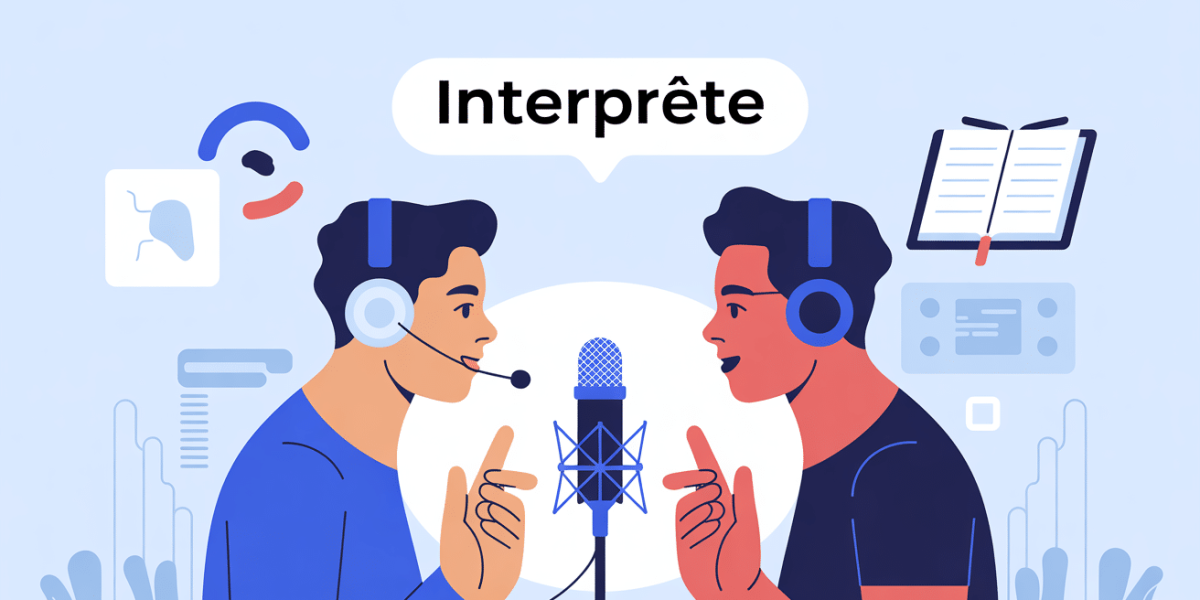
As soon as the profession of interpreter is invoked, one regularly thinks of an invisible trait of union, which makes the discussion between people not speaking the same language fluid. Unlike the translator – who focuses on writing – the interpreter intervenes in real-time exchanges, where improvisation coincides with the requirement of rigour. On the ground, we meet this professional in sometimes unexpected places: courts, congresses, hospitals, public institutions or international negotiations.
According to many trainers, the great particularity of the profession lies in the ability to transmit immediately and faithfully not only the words, but also the tone, the implied, the sensitivity of the moment. For example, most international conferences ask for at least two interpreters who are constantly relativising – the concentration requested sometimes friezes mental acrobatics! (It is not uncommon to see agencies impose the binome for simultaneous, precisely to preserve quality over time. )
What does an interpreter's daily life look like?
- Provide oral translation in important meetings or negotiations, including in official contexts
- Play a key role in sensitive environments – judicial system, medical sectors, administrative procedures
- Allow multilingual events to remain accessible: seminars, webinars, congresses
- Accompany non-French delegations or visitors on trips abroad
600 Translators/interpreters authorised in France: This is the number of people registered by AFTCom, reflecting a living, multiple and dynamic sector.
What are the big types of interpretation?
The term « interpreter » covers a number of relatively different approaches, sometimes unknown: each method is applied according to the context, the number of participants and the technicality of the mission. Opting for the right technique is not a detail, especially when the rules of the game differ between a confidential dialogue and a diplomatic summit.
Simultaneous interpretation
Most common image: professionals installed in the cabin, helmet screwed on the ears. Here, while the speaker speaks, the interpreter returns almost immediately the speech in the expected language. A detail often ignored: at least two professionals per language must be provided for a standard event (practically all agencies insist on it). Maybe you're wondering why? Simply because the mental energy expenditure is considerable: the respite every 30 minutes is used not to exhaust the quality. It happened to me (as to many confreres) to live these famous « Cabin passages », and few are the professions where intellectual tension reaches such a level!
Consecutive interpretation
Here, there is no need for a booth: the interpreter listens to a part of the speech before reciting it in the other language, often with structured notes. This technique has its election grounds: interviews, small meetings, some diplomatic appointments. A university specialist recently recalled that this mode requires a real talent for synthesis, a capacity for concentration on oneself, and a good memory (sometimes the whole public waits for interpretation to revive the discussion... and it's not nothing!).
Moreover, it is not uncommon to see an interpreter « catch up » the thread of exchange in case of floating, which can really relax the atmosphere in tense discussions.
Liaison interpretation and whispering
More confidential formats, such as liaison, are valuable for small committee exchanges: health appointments, hiring interviews, business discussions... Here, the interpreter in turn facilitates both parts, in all simplicity, without particular technology.
Conversely, the whisper – or « whispering » – addresses one to two people: the interpreter transmits quietly to the ear, useful in particular in visits or restricted meetings. Recent developments show that it is quite common for remote practice to explode (visitoconference, RSI, telephone): some specialize in responding to growing demand. One participant from an association of deafness also recalled that sign language is now given real recognition: the profession adapts to all forms of communication.
What skills and training to become an interpreter?
Engaging in the profession requires much more than a correct mastery of a foreign language. It is better to consider a high level of technicality, combined with human qualities such as listening, stress management or empathy. A master (Bac + 5) specializing in interpretation or translation is a regular recommended starting point.
Little field anecdote: many professionals immerse themselves in last minute glossaries to prepare an intervention in an unknown sector. Some agencies point out that this makes the difference between an ordinary service and a really relevant accompaniment...
It's best to remember some of the essentials:
- Training: Bac + 5 generally recommended (Master translation-interpretation)
- Certifications: ISO 9001:2015 for agencies, judicial oath to intervene in court
- Excellent mastery of foreign languages, both oral and written – including French
- Specialisation in a sector such as medical, technical, legal or conference, often valued
There is often a number for trainers: at least one must count two years practice supervised after graduation before feeling comfortable whatever the context. An experience that is sometimes full of unexpected events: for example, a young interpreter discovers at the last moment the reality of an unexpected technical sector!
Good to know
I recommend that you plan a solid supervised practice of at least two years after graduation to feel at ease in all interpreting contexts, as the profession often reserves unexpected circumstances, especially in technical sectors.
How to choose an interpreter or a trusted provider?
The reliability of the professional is the key to the mission. It is better to check certain criteria to avoid bad surprises.
Start by looking at certifications: ISO 9001:2015 remains a reference for quality, while sworn interpreter status prevails for the judiciary. Respect for confidentiality (often contractual) is particularly important in areas of risk; and for specialized areas, no hesitation, a confirmed experience must be required. A training director admits that she systematically asks her trainees to learn about the tools used and the preparation – a guarantee of serious support.
Which benchmarks facilitate the right choice?
Just like the job of Director: a trade with multiple facets between management, technical and relational, the interpreter requires great versatility and ability to adapt quickly to different contexts.
Just like the profession of composer today: role, inspiration and changing sectors, the interpreter is based on a unique combination of technical and artistic skills adapted to modern needs.
Just like the interpreter,sound engineer salary: realities, factors and concrete perspectives depends on technical expertise and adaptation to the specific requirements of each project.
- Focus on experience and training (the majority have a Master's degree; two years of activity are regularly considered as a minimum)
- Control the holding of certifications (ISO, swearing-in according to context)
- Compare rates via online simulators (count 80 to 130 € time according to technicality and urgency)
- Take the time to read different customer returns to assess reputation and reliability
One thing to remember: availability remains a recognized advantage, especially in certain emergency situations. Some agencies open their slots until 9pm on weekdays or even on weekends (including AFTCom), an asset regularly appreciated by customers in a hurry.
What opportunities and prospects for change?
It is clear that the interpreting sector is still very dynamic, even in the face of the constant breakthrough of digital tools. The missions cover many horizons: international conferences, companies, institutions, the medical or legal sector – not to mention the remote services, which have been exploding for a few years.
A notable fact: more than one third of interpreters are self-employed or wage-carrying; flexibility that seduces many professionals. Based on AFTCom figures, more than 600 approved interpreters are in exercise, and this on all hexagon.
In terms of earnings, the differences are frank – at the beginning of a career, an employee may be paid 2,000 to 2,600 € Gross per month; but the fees at the mission, especially in simultaneous or in rare languages, exceed regularly 500 € day. Some note that technical sector experts also combine several types of missions to ensure a good balance.
The technological adaptation is gradually necessary: to develop new skills, to appropriate the RSI (Remote Simultaneous Interpretation) tools... it is not always obvious! A professional speaker recently noted that ensuring technical quality « Remote » requires as much reactivity as on site, if not more.
Practical resources and guides for guidance
It is best to take advantage of the online tools today: quote simulators, service comparison, FAQ... they allow you to quickly estimate rates and criteria according to your needs. Some large agencies even offer case studies and testimonies gathered in the field – a useful way to dive into the reality of the profession.
To find a certified professional or discover an advanced training course, choose specialist directories or contact areas available online – some are accessible until late evening, sometimes even on weekends (some customers appreciate this rare flexibility in the field).
| Tool/Service | Utility |
|---|---|
| Simulator of estimate | Immediate estimate of rates by type, language, duration |
| Authorized interpreter search | Access to certified profiles (AFTCom, official directories) |
| Comparison tables | Rapid visualisation of differences between services and costs |
| FAQ, business guides | Concrete answers to frequently asked questions – including for conversions |
Finally, keep in mind that the human dimension never disappears behind the tool: choosing an interpreter or starting a training, is to focus on listening, reliability and the passion that drives transmission. What if there's any doubt? Often, experienced advisors are available to accompany each step and reassure, whether it is a first information take or a decisive choice for the future.
Updated on 23 March 2026