Published by: Guillaume Martin — Editor in Chief
Updated on 23 March 2026
Planning an artistic journey is primarily about structuring your experience to maximize your creativity, encounters and personal evolution. Whether you're an amateur or already initiated, organizing this type of journey makes it possible to transform a simple desire into a real lever of progress: from inspiration on the spot to practical implementation, each step counts. This guide details adapted methods, effective advice and resources directly mobilized to prepare your creative journey with the required rigour and sensitivity.
Contents
The benefits of an artistic journey for your personal practice
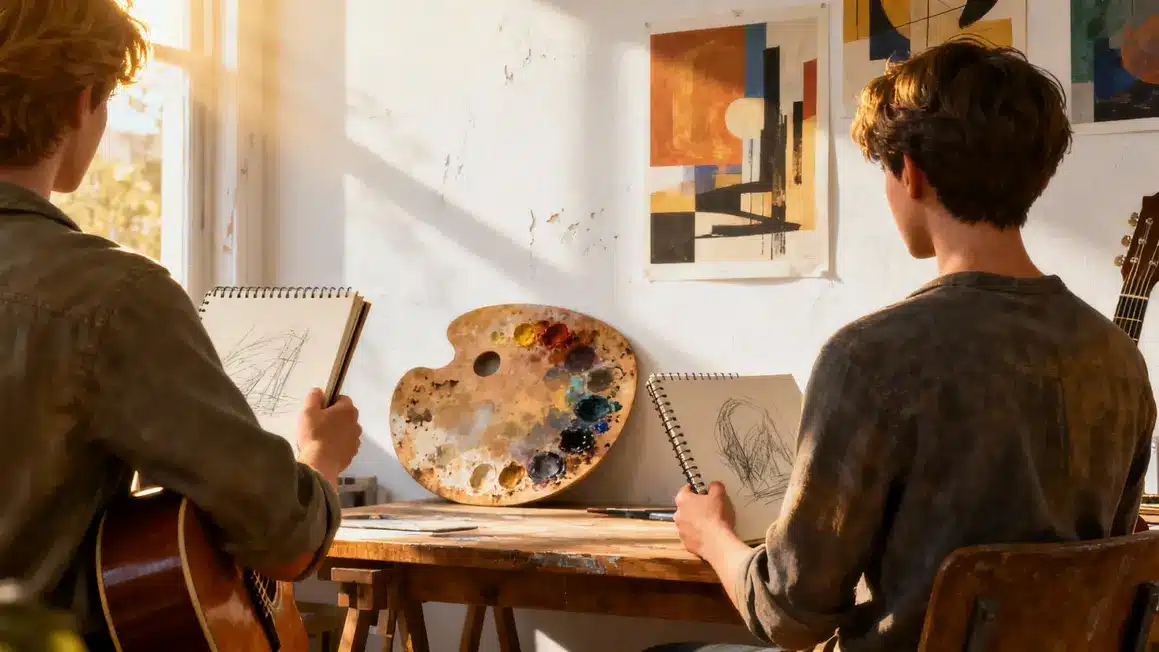
An art-based trip causes a real invigorating shock for your creativity. Get out of your usual environment, observe other practices, meet new horizons, all this moves your markers and enriches your creative palette. Several examples illustrate this impact: after encounters in India where the musical tradition was based on digital tools, I was able to report on the new techniques of beats and percussion directly tested in my workshops. Inspiration on site is also about touching new subjects, seeing how local artists integrate their culture with contemporary media, which is not observed at a distance or on screen.
Changing the scenery also means changing your gaze. Explore an industrial city or remote countryside, stroll through historic alleys or attend street festivals, all of which stimulate different ways depending on your field: music, writing, design, video. This diversity takes you out of the mental routines and generates new ideas that can be exploited immediately in your projects or in your post-travel sessions.
The journey is finally the encounter with other creators and sometimes unexpected methods. Immersing yourself in a collective workshop or discussing an exhibition puts into perspective the link between traditional practices and technical innovations. On your way home, you will not only discover tools or inspirations, but also take a step back from your own pace and organization, making it easier to manage stress or doubts.
How to choose the ideal destination according to your creative aspirations
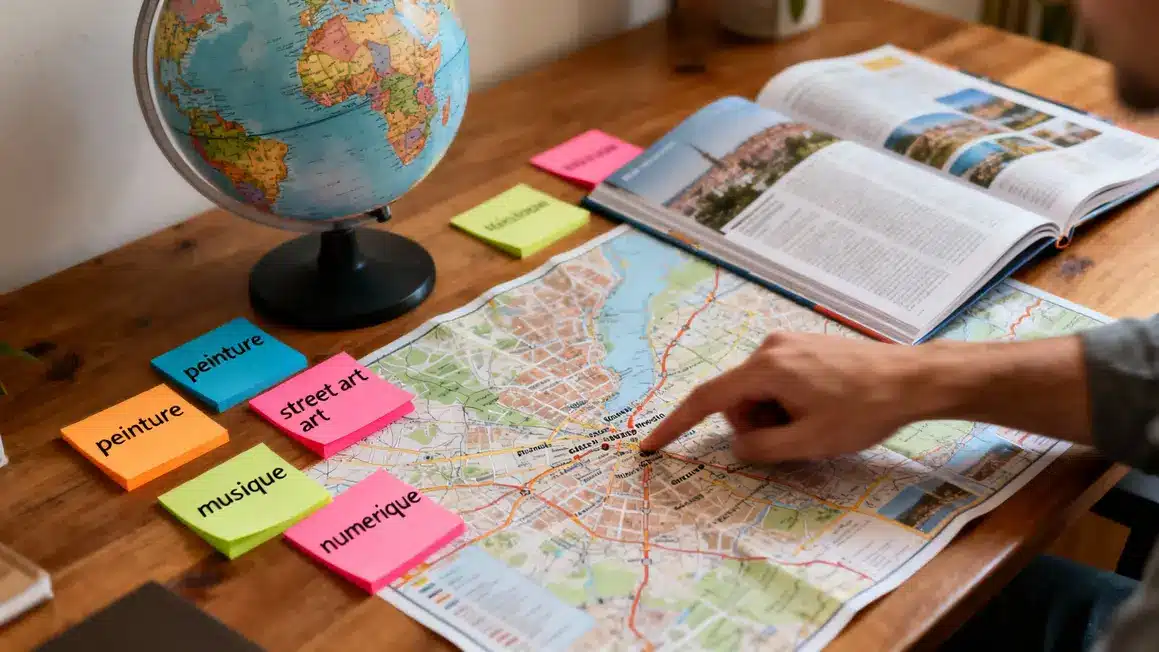
The choice of place is fundamental. Select your destination based on the type of practice you want to experience: classical painting, digital art, street art, crafts, writing. Each city offers particularities: Florence for classic painting, Tokyo for Digital Art, Miami or Paris for street art, Berlin for alternative studios.
- Identify the main activities that really fit you.
- Select some workshops or festivals to go further.
- Budget your stay: accommodation, transport, food and above all workshops and ticketing Local.
- Think about accessibility and season: climate, connections, mobility.
- Take into account the timing of the major events: Venice Biennale, Art Basel Miami, seasonal workshops.
| Destination | Type of Art / Activities | Estimated budget | Ideal time |
|---|---|---|---|
| Paris | Classic museums, painting workshops | Moderate to high | Spring – Autumn |
| Tokyo | Immersive digital art, technologies | High | Winter – Spring |
| Miami | Street art, contemporary galleries | Moderate | Winter |
| Florence | History of art, restorations | Moderate | Spring – Summer |
The more the choice is aligned with your aspirations and budget, the more you enter into a productive dynamic where each exploration directly feeds your projects.
Develop an inspiring and structured artistic itinerary
Set yourself a flexible pace: the goal is never to chain activities with forced march, but to allow improvisation. Set up days in three stages (morning strong inspiration in a museum or neighborhood, afternoon practical workshops, evening recovery or strolling where you note and synthesize what you just tested). In Florence, for example, starts at the Offices, following with an outdoor workshop, ends the evening in the light of Ponte Vecchio with sketches or notes.
- Plan activities « backup » for unforeseen events.
- Plan each morning a mini-checklist: a place to explore, a creation to make, a decompression break.
- Give yourself time to observe without pressure to give birth to frank ideas.
Book workshops, visits and activities in advance
The most authentic artistic experiences are gathered by preparing well upstream. Go through specialized platforms, consult the local pages or contacts directly and look at the tourist offices directories. For digital immersions (such as teamLab in Tokyo), reserve two weeks in advance. Tip: Choose less frequented slots to avoid crowds and enjoy fully.
- Checks the cancellation policies for each workshop or visit.
- Uses apps like Journi or Google Keep to organize and store confirmations and tickets.
- Locate activities according to proximity to your accommodation places.
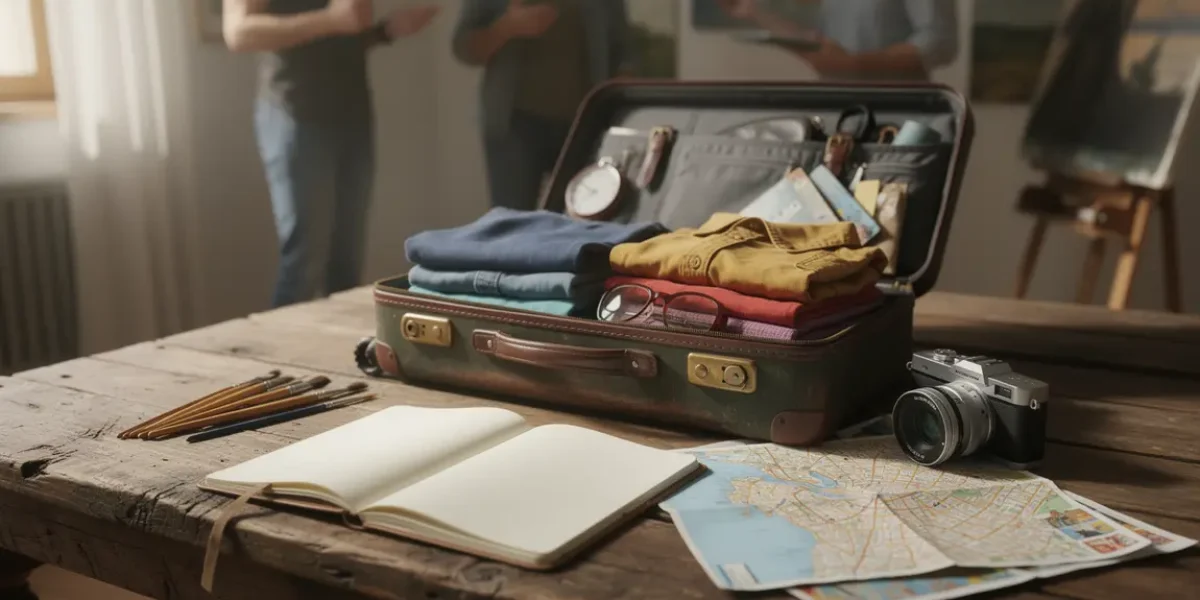
Travel light and well equipped for your roaming creations
Optimizes the contents of your bag: an A5-size sketchbook, watercolorable pencils, a watercolour mini-kit, and quality paper (avoids moisture and poor rendering), a portable lamp for night sessions and a waterproof bag to protect your equipment. For creative documentation, mobile applications such as Artivive or Journi allow you to digitize on-site without dizzying.
- Modular compartment bag for quick access to your essential tools.
- Always add a cover adapted to weather conditions and transportation.
- Store on USB drive and cloud to secure your creations.
Optimization of the budget for a tailored creative trip
Group accommodation, transport and tickets on the same central sector to limit lost time and spending. Museum passes are often a good deal (New York CityPASS, I Amsterdam City Card). Observe hourly promotions and prefer tickets off weekends or after 5pm. Privileged bikes and public transport to save on site.
| Destination | Budget Accommodation (€/night) | Cost Pass Museums (€) | Transport |
|---|---|---|---|
| New York | 150-200 | 140 | MetroCard (~33 €/week) |
| Amsterdam | 80-120 | 65-135 | Tram day pass (~8 €/day) |
Choose the best period for maximum artistic impact
The moment of the journey strongly influences the experience. Favours off-season periods (fall in Paris, spring in Miami) to escape the crowd and enjoy major events. Consult the calendars of international festivals (Biennale de Venise, teamLab Planets in Tokyo, Documenta in Kassel) to synchronize your stay with the key dates.
To enrich your artistic journey, discover how long to plan to visit Giverny and enjoy its gardens, an emblematic place to soak up Monet's universe.
Also think about exploring the best travel gift ideas for adventurers, perfect to immortalize your artistic discoveries or inspire your creations.
To feed your inspiration before leaving, explore the Challenge #TussenKunstEnQuarantine: how to reinterpret famous art works with creativity and let your imagination flow.
| 25 October | Location | Period |
|---|---|---|
| Venice Biennale | Venice, Italy | May to November |
| Art Basel | Miami, USA | Spring |
| teamLab Planets | Tokyo, Japan | Autumn |
| Documenta Kassel | Kassel, Germany | June to September |
Adapt to the unexpected for a serene and productive trip
The unexpected is part of the process. Always prepare a plan B: alternative workshops, local bookstores, discussions with local designers. If an activity falls by water, grab the moment to chew the surrounding atmosphere or improvise a collective creative session. Out-of-program discoveries often enrich projects more than the strict roadmap.
- Provide several alternatives in case of cancellation.
- Diversify your techniques to adapt to material constraints.
- Open yourself to unexpected meetings, sometimes a simple exchange inspires a new approach.
Integrate your learning when you return and into your long-term practice
An inspiring journey does not stop when you return. Group your tracks: notebook, photos, sketches, texts. Class them, digitize them, and integrate them into your online creative space or portfolio. These archives serve as a basis for future projects and, if shared, may open unexpected collaborations. Intensifies their impact by working them regularly, not just in memory.
- Consecrate a niche every week to deepen ideas gleaned on a journey.
- Share your work to raise feedback and initiate new exchanges.
Frequently Asked Practical Questions on Artistic Travel
- Organization of days : divides morning, afternoon, evening, alternating inspiration, creation and rest. Adapts every day to your energy level.
- Equipment insurance : check the guarantees of your home contract or subscribe a specific travel cover including creative objects.
- Lack of inspiration Return to the observation of a detail (croquis, haiku, snapshot), explore new off-road locations or perform a mini-cadré exercise.
- Adapted equipment : solid notebook, compact pens or brushes, portable scanner, double storage (USB and cloud).
- Fatigue : installs a flexible routine, alternate highlights and breaks, snacks and drinks to maintain energy without forcing.
Planning an artistic journey means offering the opportunity to progress intensely while discovering new creative territories. Structure your itinerary, equip smartly, choose the period and anticipate hazards, everything helps to make better use of the trip. Now, what concrete actions do you envisage for your own artistic project? What steps or tricks have you already tested during your preparations? Share your thoughts and experiences with the community in the comment space!
If this content has helped organize your approach, share it with your contacts or networks to broaden the discussion around effective creative travel. And to go further, what aspects of post-travel planning or management do you want to explore in the near future? Ask your questions or suggest your leads to structure a next file!
(To deepen the topic and find reliable resources, you can consult the official sites of major cultural institutions or specialized platforms such as GetYourGuide, Airbnb Experiences, or the tourist offices of artistic cities.)
Article written by Guillaume Martin, author and multidisciplinary creator. A specialist in creative pedagogy, he has been accompanying hundreds of practitioners since 2013 in organizing autonomous artistic projects and structuring portfolios.
Updated on 23 March 2026