Published by: Guillaume Martin — Editor in Chief
Updated on 23 March 2026
Mastering the evolutions of iconic painting styles and techniques allows you to have a real benchmark to progress, refine your practice and understand what distinguishes a simple result from a built creative approach. Here is how the major currents and their methods have been structured: they are impossible to progress without facing their specificities and their ability to influence today's projects.
Contents
Painting styles through history
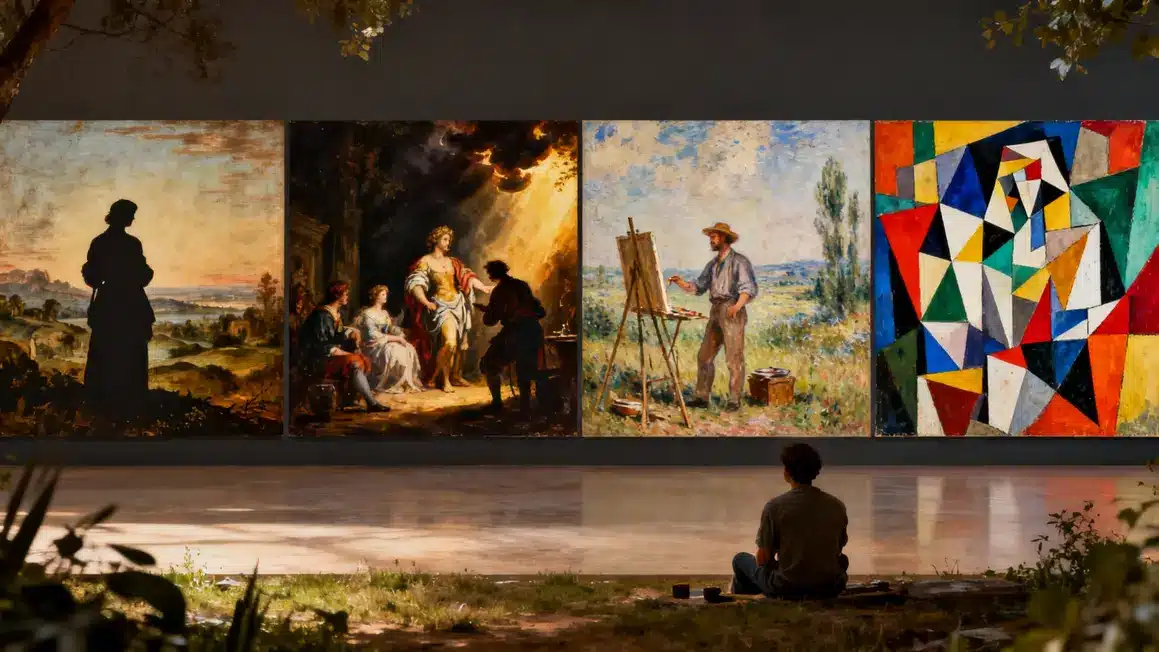
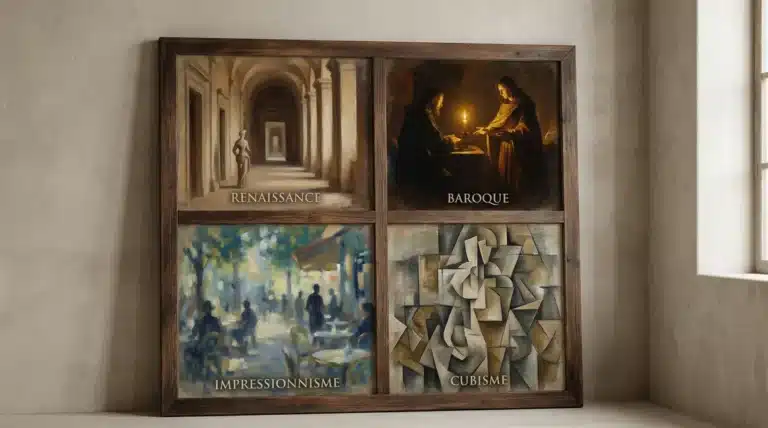
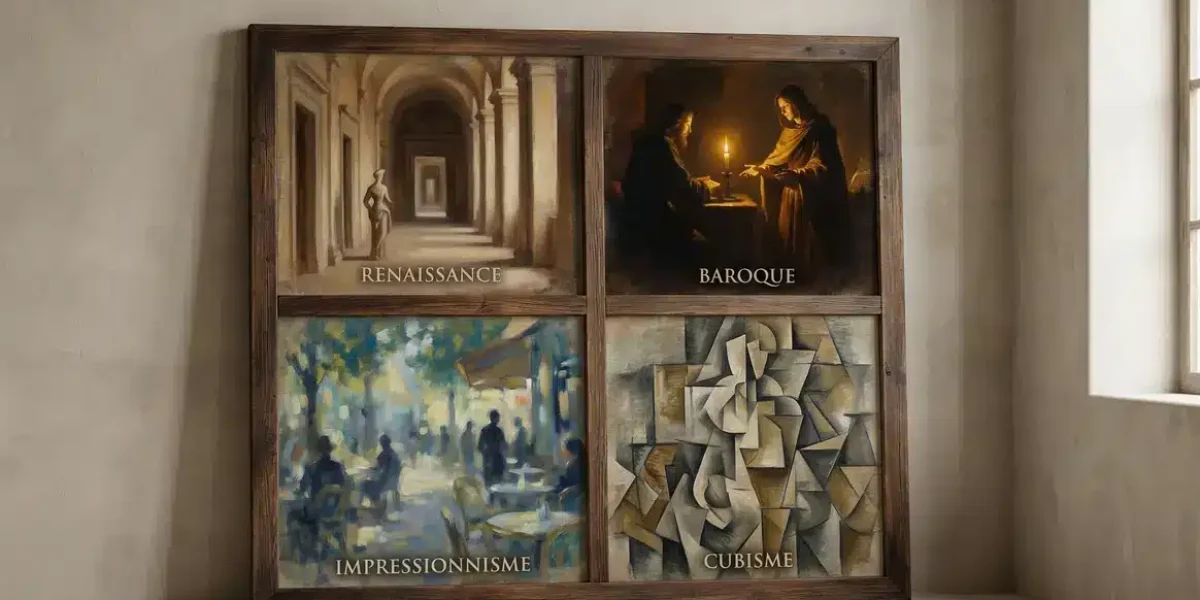
The painting has undergone many transformations according to the movements, each imposing major breaks that still impact our markers. In the Renaissance, in the 15th century, the linear perspective introduces a true depth into the composition: Leonardo da Vinci and Michelangelo rely on anatomical studies and combine shadows, proportions and human stories. Gradually, painting no longer serves only a religious purpose, but becomes a living narrative.
In the 17th century, the Baroque astonished by its extreme contrasts and the dramatization of the staging. Look at a work by Caravage: clear dark It channels light on central subjects, seeking above all to provoke immediate emotion. This visual language is not neutral: it serves the intentions of the Church and transforms every detail into a significant moment.
In the 19th century, Impressionism pushed the codes even further: artists came out of the workshops and painted in the open air, multiplying the quick keys and the search for the vibrating light. Discoveries on the prism of colors move from science to canvas with Monet, Renoir, Degas. This way of grasping the suspended moment reflects the change in relation to reality and time.
Cubism, under the impulse of Picasso and Braque in the 20th century, explodes the notion of a unique point of view: here, the fragmentation of forms and multiple perspectives question the very perception of reality. This technique is also a reflection of a world that is marred by innovation and crises. Impose your own visual logic becomes a strong artistic gesture.
In parallel, Pop Art explores the consumer society since the 1950s: Andy Warhol diverts daily life, makes an iconic soup box, multiplies the colorful series that question culture and media. Each artistic movement, well beyond its stylistic break, always questions the historical context, philosophy and technique. Their influence does not stop at the museum.
Decryption of emblematic techniques by artistic movement
- Linear perspective (Renaissance): an illusion of depth obtained by lines converging towards a point of leakage. Tools: ruler, compass, wooden support, precise pigments. Geometric rigor dominates.
- Clear dark (Baroque): subtle play between strong light and shadows, creating relief and dramatic effect. Oil glacis, successive gradients, narrative mastery: light becomes a main actor.
- Alla prima (Impressionism): direct, fast paint, made in a single layer. The colours mix on the canvas, the touch is visible, the luminous spontaneity prevails. The paint tubes facilitate this approach.
- Geometric Fragmentation (Cubism): deconstruction and recomposition of subjects to offer several points of view at once. Collages, knives, various materials, sober tones. It is also a reflection on how we perceive an object or a scene.
Each technique, far from being simply decorative, is the driving force behind a new look at the world and the creative process.
The artists who marked the great movements of painting
- Leonardo da Vinci (Renaissance): « The Supper », « The Mona Lisa ». Merges science and art to inspire an entire generation. The perspective here serves the narrative.
- Claude Monet (Impressionism): « Impression, rising sun ». Privileges light, exterior, ephemeral sensation.
- Pablo Picasso (Cubism): « The Ladies of Avignon ». Destructure everything, invent its own rules and impose a new pictorial space.
- Andy Warhol (Pop Art): Campbell soup boxes, Marilyn Monroe. Question the boundary between popular culture and art, revisits common objects with irony and systematism.
Their legacy lies not only in the works produced but in having pushed back the conventions, inspiring subsequent generations to experiment and invent.
Mastering the different pictorial currents often requires a solid understanding of the concrete techniques and essential tools for beginners, essential to structure its artistic progression.
To broaden your artistic horizons, why not take inspiration from the techniques explored in the ceramics in Paris: 7 workshops selected to advance and create ?
Just like the influential directors: 7 filmmakers who have transformed the history of cinemaThe great masters of painting have been able to mark their time thanks to innovative techniques and a unique artistic vision.
Understanding evolution through comparison
Comparing great styles allows you to spot what changes in the representation, the use of color or the construction of the subject. The Renaissance is seeking balance, Cubism is changing everything, Impressionism values light, Realism translates raw life, Pop Art plays visual shock.
| Style | Composition approach | Light treatment | Use of colours | Main themes |
|---|---|---|---|---|
| Renaissance | Linear perspective, balance | Subtle degraded, naturalism | Realistic nuances | Religion, mythology, humanism |
| Baroque | Dynamism, dramatization | Clear dark | Strong contrasts | Emotion, faith, theatricality |
| Realism | Daily life | Natural light | Earthy tints | Social, rural, labour |
| Impressionism | Opening, lightness | Changing light | Light effects | Nature, leisure, instant |
| Cubism | Fragmentation, multiple perspective | Light not treated | Deaf colors | Abstraction, common objects |
| Pop Art | Repetition, important reasons | Uniform tincture | Bright colors | Consumer, media |
Contemporary applications in interior decoration
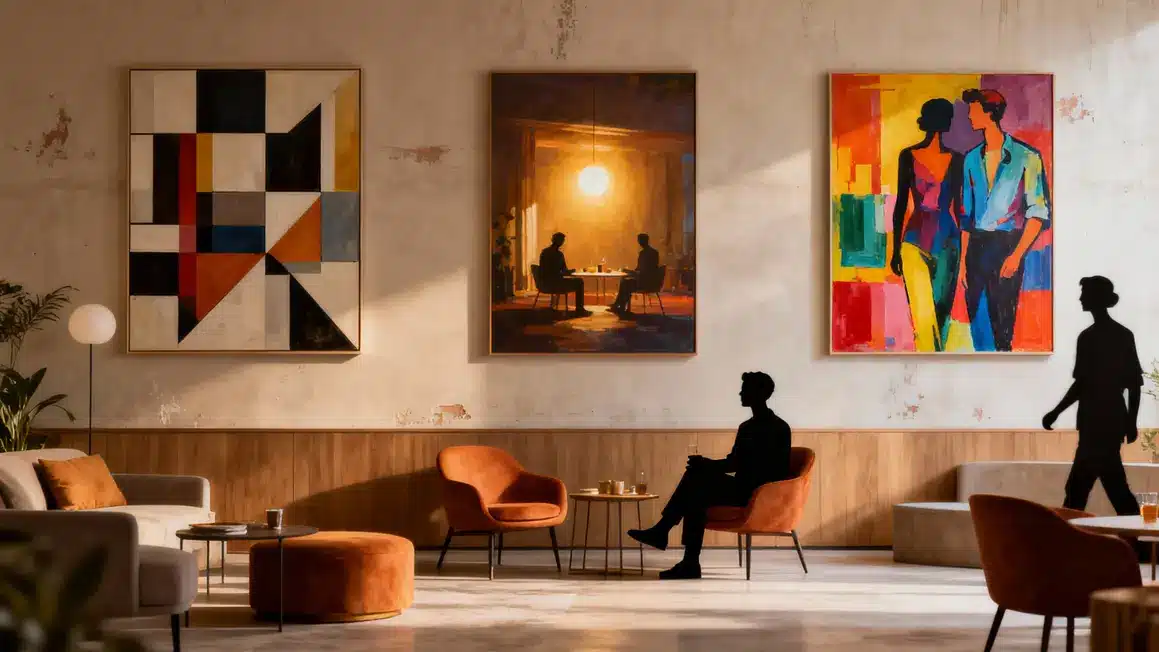
Highlighting historical styles in modern design makes it possible to affirm the identity of a room while valuing aesthetic coherence. The Pop Art energizes open spaces with its colours and patterns, ideal to stimulate a living room. The Cubism perfectly integrates into an office thanks to works with geometric and structural shapes. The RealismOn the other hand, it embellishes intimate corners like the rooms, thanks to its human and organic scenes. Mixing styles and locations: this is the best way to avoid monotony and encourage discovery.
| Picture Style | Ideal piece | Atmosphere created |
|---|---|---|
| Pop Art | Living room, open space | Energy, contrast |
| Cubism | Desk, dining room | Structure, reflection |
| Realism | Room, reading corner | Sobriety, comfort |
Frequently asked questions about styles and techniques
- Pop Art : Inspires from mass culture, uses screen printing and frank colours to revisit everyday objects.
- Cubism : Geometric analysis, several angles at once, analytical phase then synthetic with collages.
- Realism : Accuracy of detail, subjects of daily life without idealization, ordinary scenes that become source of authenticity.
Distinguishing a work is based on the intent of the movement and tools: popular icons (Pop Art), deconstructed objects (Cubism), real moments (Realism). Everyone continues to influence today far beyond painting through visual, graphic or fashion arts.
Understanding great styles and pictorial techniques is useful for structuring your own approach and undertaking with more meaning, whatever your level. These historical and practical landmarks are still relevant in the most contemporary creative approaches. Besides, what movements or techniques influence your practice today or stimulate your curiosity? Share your point of view with comment and help the community move forward. If this article brought new keys, convey it, because the diversity of experiences enriches each creator. Need more records on artistic methods? Suggest your themes and help change content.
Information sources : Centre Pompidou, Tate Modern, Encyclopaedia Universalis, educational records of the National Museums.
Updated on 23 March 2026